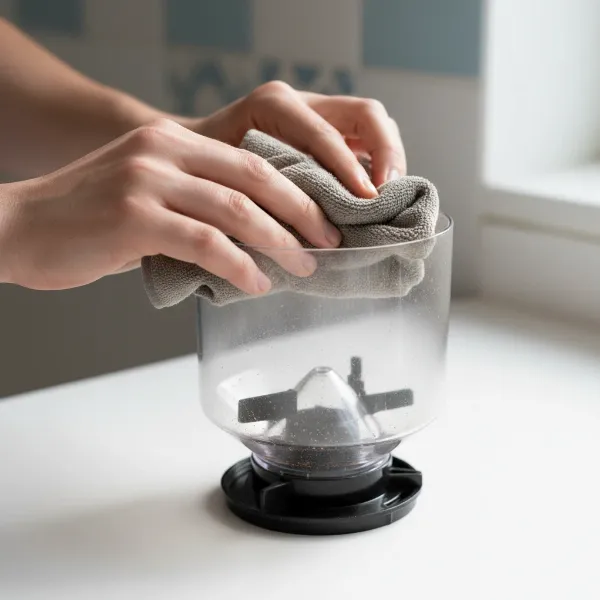
The quest for the perfect espresso at home is a passionate journey, filled with anticipation for that rich aroma and exquisite taste. Many coffee enthusiasts begin by upgrading their beans and espresso machine, only to overlook one of the most critical components: the coffee grinder. It’s a common misconception that any grinder can handle the job, but when it comes to espresso, a blade grinder is a fundamental misstep. This type of coffee grinder simply cannot deliver the consistent, fine grind required for a truly exceptional espresso shot. We’re here to explain exactly why blade grinders fall short for espresso and guide you toward achieving barista-quality results in your own kitchen.
Understanding Coffee Grinders: Blade Grinders vs. Burr Grinders
The fundamental difference between blade and burr grinders lies in their mechanism and, consequently, the quality of the coffee grounds they produce. Understanding this distinction is key to appreciating why certain grinders are unsuitable for espresso.
Blade Grinders: The Chopping Method
|
Our Picks for the Best Coffee grinder in 2026
As an Amazon Associate I earn from qualifying purchases.
|
||
| Num | Product | Action |
|---|---|---|
| 1 | OXO Brew Conical Burr Coffee Grinder - Silver, Stainless Steel Burrs, One-Touch Automatic Smart Grind |

|
| 2 | Hamilton Beach Fresh Grind Electric Coffee Grinder for Beans, Spices and More, Stainless Steel Blades, Removable Chamber, Makes up to 12 Cups, Black |
|
| 3 | Cuisinart Coffee Grinder, Electric One-Touch Automatic Burr Coffee Grinder with 18-Position Grind Selector, Cup Size Selector for 4 – 18 Cups, DBM-8P1, Black Stainless |
|
| 4 | Automatic Coffee Machine, 20-Bar Pressure Espresso Maker with Built-in Grinder, 15-Precision Settings, One-Touch Latte & Cappuccino System, Smart Self-Cleaning |
|
| 5 | SHARDOR Professional Conical Burr Coffee Grinder, Coffee Bean Grinder with 48 Grind Settings for Espresso, Drip & French Press, Upgraded Anti-Static Technology, Precision Timer, Stainless Steel |
|
| 6 | Cuisinart Coffee Grinder, One Touch Control Coffee Bean Grinder with Stainless Steel Bowl and Blades, 2.5 oz/70g Capacity Enough for 12 Cups, On/Off Switch with Safety Interlock, DCG-20BKN, Black |
|
| 7 | Hamilton Beach Custom Grind Electric Coffee Grinder for 4-14 Cups, One-Press Hand-Free Operation with Auto Shutoff, Removable Grinding Bowl For Easy Pour and Clean, Stainless Steel (80406) |
|
| 8 | Wancle Electric Coffee Grinder, Spice Grinder, One Touch Coffee Mill for Beans, Spices and More, with Clean Brush Black |
|
| 9 | Amazon Basics Electric Coffee Grinder, Coffee Bean and Spice Grinder, With Heavy-Duty Stainless Steel Grind Blades |
|
| 10 | BLACK+DECKER One Touch Coffee Grinder, 2/3 Cup Coffee Bean Capacity, Spice Grinder, One Touch Push-Button Control -150 Watts -Stainless Steel Blades |
|
Blade grinders operate much like a kitchen blender. They feature a spinning blade that rapidly chops and shatters coffee beans into smaller pieces. The fineness of the grind is controlled by how long you allow the blades to spin. While simple and often inexpensive, this method is inherently flawed for serious coffee preparation. The impact of the blades creates an inconsistent mix of particles, ranging from very fine dust, often called “fines,” to larger, chunkier “boulders.” This lack of uniformity is the primary reason why blade grinders are detrimental to espresso quality.
Burr Grinders: The Crushing Precision
In contrast, burr grinders feature two abrasive surfaces, or “burrs,” that crush coffee beans between them. The distance between these burrs is adjustable, allowing for precise control over the grind size. As beans pass through the burrs, they are consistently ground to a uniform particle size. Burr grinders come in two main types: conical burrs (cone-shaped) and flat burrs (two parallel rings). Both types excel at producing consistent grinds, which is absolutely essential for extracting the delicate flavors of espresso properly.
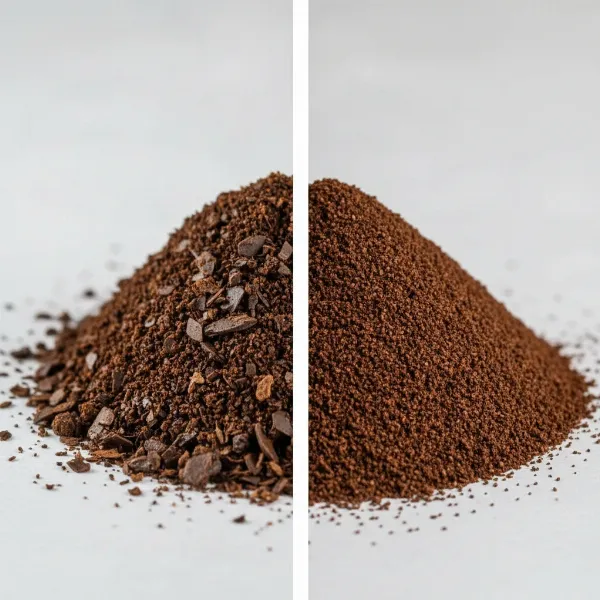 Visual comparison of inconsistent blade-ground coffee versus uniform burr-ground coffee for espresso
Why Grind Consistency is Non-Negotiable for Espresso
Espresso brewing is a highly precise process that demands a specific and uniform coffee grind. The science behind it reveals why consistency isn’t just a preference, but a strict requirement for a delicious shot.
The Science of Extraction
When you pull an espresso shot, hot, pressurized water is forced through a compacted bed of coffee grounds. This process extracts soluble compounds that contribute to the flavor, aroma, and body of your coffee. If your grind is inconsistent, with a mix of fines and boulders, you’ll inevitably encounter problems. The fine particles will over-extract quickly, releasing bitter, acrid flavors. Meanwhile, the larger particles, or boulders, will under-extract, leading to sourness and a watery, weak taste. The result is an unbalanced, muddy, and unpleasant espresso shot that lacks depth and clarity.
The Espresso Pressure Cooker
Espresso machines operate under high pressure (typically 9 bars) and have a very short extraction time, usually between 25 to 30 seconds. This combination means there’s little room for error. A consistent, finely ground coffee bed creates the ideal resistance, allowing the water to evenly saturate the grounds and extract flavors at a controlled rate. With an inconsistent grind from a blade grinder, water will find the path of least resistance, rushing through the coarser particles and channeling, while bypassing other areas. This leads to uneven extraction, where some parts of the coffee puck are over-extracted and others are under-extracted, further compounding flavor issues.
The Crema Conundrum
A hallmark of a well-pulled espresso shot is the rich, reddish-brown layer of crema on top. Crema is formed by the emulsification of coffee oils and gases during the high-pressure brewing process. While not solely an indicator of taste, a stable, uniform crema is a visual cue of proper extraction. Inconsistent grinds from a blade grinder disrupt this delicate process, often resulting in thin, bubbly, or quickly dissipating crema, a clear sign of poor espresso quality.
The Fatal Flaws of Using a Blade Grinder for Espresso
Let’s delve deeper into the specific reasons why a blade grinder is simply incompatible with crafting a superb espresso.
Inconsistent Particle Size: The Root Cause
The most significant drawback of a blade grinder for espresso is its inability to produce a uniform particle size. Instead of grinding, it essentially smashes and chops the beans. This creates a wide distribution of particle sizes – from almost dust-like “fines” to visibly large “boulders.” For espresso, this is catastrophic. The fine particles create excessive resistance and over-extract quickly, imparting bitterness. The large particles offer too little resistance and under-extract, resulting in sourness and a lack of body. The conflicting flavors from these vastly different extractions create a muddled, unsatisfying cup.
Lack of Precision and Control
Espresso preparation requires meticulous control over grind size to “dial in” the perfect shot. Even a slight adjustment can drastically change the extraction time and flavor profile. Blade grinders offer no such precision. Your only control is the duration of grinding, which makes it impossible to achieve the minute, repeatable adjustments necessary for espresso. Without the ability to fine-tune your grind, you’re left guessing, and consistently good espresso remains an elusive dream.
Heat Generation and Flavor Degradation
The high-speed spinning blades of a blade grinder generate significant friction and heat. This heat can be detrimental to the delicate coffee beans. Coffee contains volatile oils and aromatic compounds that are responsible for its rich flavor and aroma. When exposed to excessive heat during grinding, these precious compounds can evaporate prematurely. In some cases, the heat can even cause a slight “baking” or “pre-roasting” of the grounds, leading to a burnt, flat, or off-flavor in your final espresso shot. This subtle but impactful degradation robs your coffee of its true potential.
The Myth of “Fine Enough”
You might be tempted to run a blade grinder for a long time, assuming that enough chopping will eventually produce grounds “fine enough” for espresso. While the resulting powder might look fine to the naked eye, a closer inspection (or taste test) reveals its true nature. It’s not a uniform fine grind; it’s a mix of extremely fine dust and larger irregular chunks. This heterogeneity will still lead to the same uneven extraction problems, making it impossible to pull a balanced and flavorful espresso shot. The fineness required for espresso isn’t just about particle size, but about the consistency of that particle size.
Investing in Your Espresso: The Burr Grinder Advantage
If you’re serious about making great espresso, investing in a quality burr grinder is not an option; it’s a necessity. It’s arguably the single most impactful upgrade you can make to your home espresso setup.
Manual Burr Grinders
For those on a tighter budget or who appreciate a hands-on approach, a manual burr grinder is an excellent starting point. These grinders utilize conical burrs and a hand crank to crush beans, offering surprisingly consistent results. While requiring more effort and time, especially for multiple shots, they provide significant control over grind size compared to blade grinders. They are also portable and relatively quiet, making them a great entry into the world of proper espresso grinding.
Electric Burr Grinders (Conical & Flat)
Electric burr grinders offer convenience, speed, and superior consistency. They are available with either conical or flat burrs, both of which are capable of producing the fine, uniform grind necessary for espresso. High-quality electric models feature multiple grind settings, often with micro-adjustments, allowing you to precisely dial in your espresso. Many also include features like programmable dosing by time or weight, which further enhances consistency and workflow. While a greater investment, an electric burr grinder transforms your espresso experience, making consistent, delicious shots a daily reality.
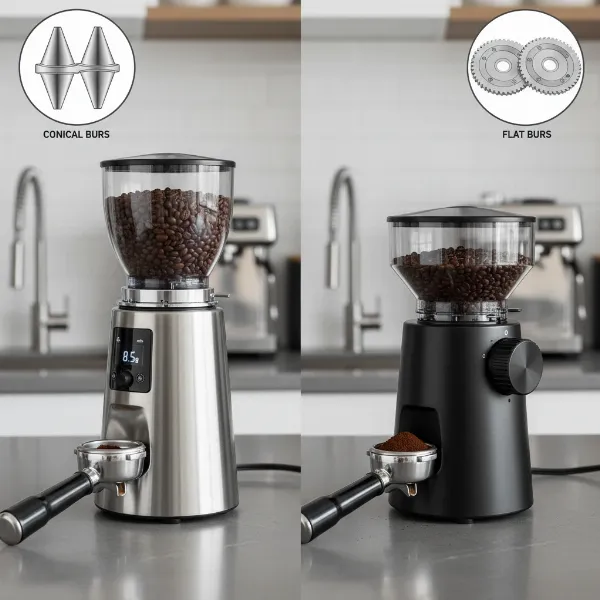 Illustration showcasing different types of electric burr grinders for home espresso setups
Choosing the Right Burr Grinder for Espresso
Selecting the ideal burr grinder for espresso involves considering a few key factors that will directly impact your brewing success.
Burr Material
Burrs are typically made from either stainless steel or ceramic. Stainless steel burrs are known for their sharpness and durability, often producing a very precise grind. Ceramic burrs are also durable, tend to be quieter, and generate less static. Both materials can deliver excellent results, so the choice often comes down to personal preference and the specific grinder’s design.
Adjustability
For espresso, a grinder with fine-tuned adjustability is paramount. Look for models with a wide range of grind settings and, ideally, micro-step or stepless adjustments. This allows you to make minute changes to your grind, which is crucial for perfecting espresso extraction and compensating for variables like bean age or humidity.
Dose Control
Many electric burr grinders offer features for dose control, allowing you to grind a specific amount of coffee by time or weight. This consistency in dosage is vital for repeatable espresso shots. Some grinders also allow you to grind directly into your portafilter, streamlining your workflow.
Budget Considerations
While burr grinders are generally more expensive than blade grinders, there’s a wide range of price points. Entry-level manual burr grinders offer excellent value, providing superior grind quality without breaking the bank. As you move into electric models, prices increase with features, motor quality, and burr size. Remember, a good grinder is an investment that will significantly elevate your espresso for years to come.
Conclusion
The journey to an exquisite espresso shot begins long before the hot water meets the grounds; it starts with the grind. While the allure of a cheap, versatile blade grinder might be tempting, it’s a path that inevitably leads to disappointment for espresso lovers. The inconsistent particle size, lack of control, and heat generation inherent in blade grinders fundamentally undermine the delicate science of espresso extraction.
Instead, embrace the precision and consistency that only a quality burr coffee grinder can offer. Whether you opt for a robust manual model or a convenient electric powerhouse, investing in a burr grinder is an investment in flavor, aroma, and the pure joy of a perfectly extracted espresso. It’s the difference between a passable coffee and a truly memorable experience.
What steps will you take to elevate your home espresso game today?
Frequently Asked Questions
Can I really taste the difference between blade and burr ground coffee for espresso?
Absolutely. The difference is stark. Blade grinders produce an inconsistent mix of particle sizes, leading to uneven extraction, which results in a muddled espresso shot that tastes both bitter (from over-extracted fines) and sour (from under-extracted boulders). A burr grinder, by providing a uniform grind, ensures balanced extraction and a much cleaner, richer, and more complex flavor profile.
What is “dialing in” an espresso shot?
“Dialing in” refers to the process of fine-tuning your espresso grind size, dose, and tamp to achieve an optimal extraction time and flavor. For espresso, this means adjusting your grinder until a shot pulls within the ideal timeframe (typically 25-30 seconds) and tastes balanced, without bitterness or sourness. This level of precision is only possible with a burr grinder.
Are manual burr grinders good for espresso?
Yes, many manual burr grinders are excellent for espresso, especially for home users or those on a budget. They use the same crushing mechanism as electric burr grinders, delivering a consistent and adjustable grind. While they require manual effort and can be slower, they offer superior grind quality for espresso compared to any blade grinder.
How fine should espresso grind be?
An ideal espresso grind should be very fine, resembling powdered sugar or fine table salt when rubbed between your fingers. It should clump slightly when pressed, indicating proper moisture content and consistency. If it’s too fine, your machine might choke; if too coarse, the shot will pull too quickly and be under-extracted.
Does heat from a grinder affect coffee flavor?
Yes, heat generated during grinding can negatively impact coffee flavor. High-speed blade grinders create significant friction and heat, which can cause volatile flavor compounds in the coffee beans to dissipate. This can lead to a less aromatic and flavorful espresso, sometimes even imparting a slightly burnt or stale taste to the final brew.