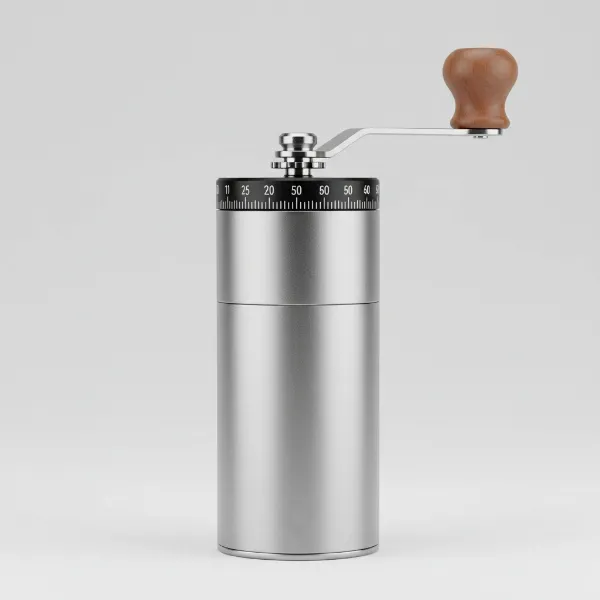
Have you ever paused to consider the incredible journey of the coffee bean before it reaches your cup? While the bean itself holds a rich history, the tools we use to prepare it have an equally fascinating story. A perfectly ground bean is the foundation of any exceptional brew, and the quest for that perfect grind has driven centuries of innovation, transforming the simple act of crushing beans into a precise art. This journey takes us from rudimentary stone tools to the sophisticated steel mechanisms we rely on today, reflecting humanity’s enduring passion for coffee.
The Dawn of Coffee Grinding: From Mortar and Pestle
Long before dedicated coffee grinders existed, early coffee enthusiasts relied on the most fundamental tools available: the mortar and pestle. In regions like Ethiopia and Yemen, where coffee cultivation first flourished, beans were traditionally crushed with stone or wooden implements. This method, while labor-intensive, offered a rudimentary way to control grind size, though consistency was often a challenge. The rhythmic sound of grinding coffee became an integral part of daily life and social gatherings, signaling the start of a cherished ritual.
As coffee culture spread across the Arabian Peninsula, a demand for more efficient grinding methods began to emerge. Innovators in the Middle East developed specialized grinding tools, some featuring grooved stone surfaces to enhance efficiency. These early designs were often portable, facilitating the spread of coffee consumption to new lands. By the 15th century, the Turks were creating some of the first dedicated coffee grinders, typically cylindrical metal devices, initially used for both spices and coffee.
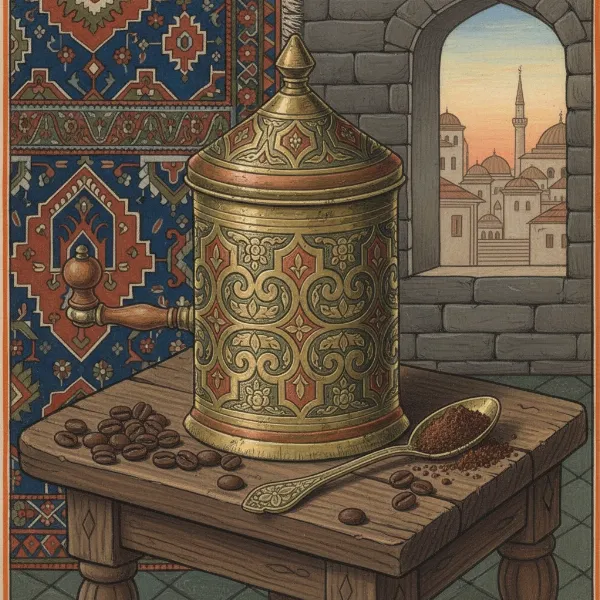 A detailed illustration of an early 15th-century cylindrical Turkish coffee grinder.
Early Mills: The Hand-Cranked Revolution (17th – 19th Century)
The true revolution in coffee grinding began to take shape in Europe. In 1665, an Englishman named Nicholas Book is credited with inventing one of the first coffee mills specifically designed for coffee beans. These early European grinders often adapted existing designs for grinding spices or grains, incorporating a hand-crank mechanism to reduce physical effort. Made from materials like iron or brass, these devices quickly became fixtures in European households and burgeoning coffeehouses, symbolizing coffee’s growing integration into daily life.
A significant leap forward came in 1779 when British blacksmith Richard Dearman invented the burr grinder. Unlike earlier methods that crushed beans somewhat inconsistently, the burr grinder utilized two revolving abrasive surfaces to uniformly grind coffee. This innovation laid the groundwork for the consistent grind sizes essential for various brewing methods that would emerge. In the United States, Thomas Bruff, Sr., received the first American patent for an improved coffee grinding mill in 1798, featuring a wall-mounted design with iron plates.
The Industrial Revolution of the 18th and 19th centuries dramatically accelerated coffee grinder development. Mass production became possible, leading to more affordable and consistent cast-iron grinders. Companies like Peugeot, which began mass-producing hand-cranked grinders around 1840, and the Arcade Manufacturing Company in the late 1800s, made coffee mills a common household item. These early burr grinders, whether box-style or wall-mounted, were not only practical but also often decorative, reflecting the era’s craftsmanship.
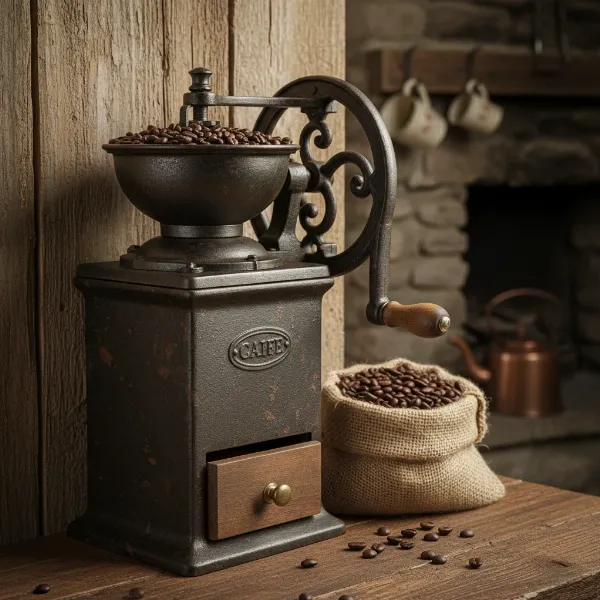 A vintage cast-iron hand-crank burr coffee grinder from the 19th century.
The Electric Age: Steel and Beyond (Late 19th Century – Present)
The late 19th century ushered in the era of electricity, forever changing the landscape of coffee grinding. The Hobart Manufacturing Company is widely credited with producing one of the first electrical coffee grinders for commercial use around 1898. These initial electric grinders were large and industrial, primarily designed for coffee production plants, restaurants, and coffeehouses.
“The shift from manual to electric coffee grinders marked a pivotal moment, transforming coffee preparation from a labor-intensive task into a process of speed and convenience.”
By the 1930s, smaller electric grinders began to appear for home use, making freshly ground coffee accessible to a broader audience. The mid-20th century saw the popularization of two distinct types of electric grinders:
- Blade Grinders: These budget-friendly options, which became popular in the 1950s, use rapidly spinning blades to chop coffee beans. While convenient, they often produce an inconsistent grind and generate heat, which can negatively impact flavor.
- Electric Burr Grinders: Building on the principle of their manual predecessors, electric burr grinders were introduced for home use by companies like Krups and Braun in the 1960s. These grinders use two abrasive surfaces (burrs) to crush beans uniformly, offering superior consistency and flavor preservation. Burr grinders are further categorized into conical and flat burrs, each with distinct advantages in grind profile and heat generation.
The 21st century has brought further advancements, pushing the boundaries of precision and convenience. Modern electric grinders incorporate durable materials like titanium and hardened steel for burrs, enhancing longevity and performance. Innovations include real-time grinding with laser analyzers, Bluetooth-enabled grinders that communicate with espresso machines, and smart technology that monitors and adjusts grind parameters automatically. These sophisticated machines exemplify the ongoing quest for the perfect cup, offering unparalleled control and consistency.
The Enduring Legacy: Why Grind Still Matters
The history of the coffee mill is a testament to human ingenuity and the enduring desire for a better cup of coffee. From the brute force of ancient stone tools to the intricate precision of modern steel mechanisms, each evolution has aimed to refine the process of transforming whole beans into flavorful grounds. This journey highlights a fundamental truth: the grind is paramount. A fresh, consistent grind is the key to unlocking the full aroma and taste potential of any coffee bean.
Today, with an array of grinders available, from traditional hand mills to advanced smart grinders, the choice allows us to connect with this rich history while enjoying the benefits of modern technology. The story of the coffee mill reminds us that every sip of coffee is a culmination of centuries of passion, innovation, and dedication to the perfect daily ritual.
Frequently Asked Questions
When was the first coffee grinder invented?
|
Our Picks for the Best Coffee grinder in 2026
As an Amazon Associate I earn from qualifying purchases.
|
||
| Num | Product | Action |
|---|---|---|
| 1 | OXO Brew Conical Burr Coffee Grinder - Silver, Stainless Steel Burrs, One-Touch Automatic Smart Grind |

|
| 2 | Cuisinart Coffee Grinder, One Touch Control Coffee Bean Grinder with Stainless Steel Bowl and Blades, 2.5 oz/70g Capacity Enough for 12 Cups, On/Off Switch with Safety Interlock, DCG-20BKN, Black |
|
| 3 | Hamilton Beach Fresh Grind Electric Coffee Grinder for Beans, Spices and More, Stainless Steel Blades, Removable Chamber, Makes up to 12 Cups, Black |
|
| 4 | Wancle Electric Coffee Grinder, Spice Grinder, One Touch Coffee Mill for Beans, Spices and More, with Clean Brush Black |
|
| 5 | BLACK+DECKER One Touch Coffee Grinder, 2/3 Cup Coffee Bean Capacity, Spice Grinder, One Touch Push-Button Control -150 Watts -Stainless Steel Blades |
|
| 6 | Cuisinart Coffee Grinder, Electric One-Touch Automatic Burr Coffee Grinder with 18-Position Grind Selector, Cup Size Selector for 4 – 18 Cups, DBM-8P1, Black Stainless |
|
| 7 | SHARDOR Professional Conical Burr Coffee Grinder, Coffee Bean Grinder with 48 Grind Settings for Espresso, Drip & French Press, Upgraded Anti-Static Technology, Precision Timer, Stainless Steel |
|
| 8 | Amazon Basics Electric Coffee Grinder, Coffee Bean and Spice Grinder, With Heavy-Duty Stainless Steel Grind Blades |
|
| 9 | Automatic Coffee Machine, 20-Bar Pressure Espresso Maker with Built-in Grinder, 15-Precision Settings, One-Touch Latte & Cappuccino System, Smart Self-Cleaning |
|
| 10 | Hamilton Beach Custom Grind Electric Coffee Grinder for 4-14 Cups, One-Press Hand-Free Operation with Auto Shutoff, Removable Grinding Bowl For Easy Pour and Clean, Stainless Steel (80406) |
|
The earliest form of coffee grinding involved using a mortar and pestle in the birthplaces of coffee. However, the first mill specifically designed for grinding coffee beans was invented by Nicholas Book in England in 1665.
What is the difference between a blade grinder and a burr grinder?
A blade grinder chops coffee beans using rapidly spinning blades, often resulting in an inconsistent grind and heat generation. A burr grinder, whether manual or electric, crushes beans between two abrasive surfaces (burrs), producing a more uniform and consistent grind that preserves flavor better.
When did electric coffee grinders become common for home use?
While commercial electric coffee grinders appeared in the late 1800s, smaller and more accessible electric models for home use became common by the 1930s. Blade grinders gained popularity in the 1950s, followed by home electric burr grinders in the 1960s.
Why is grind consistency important for coffee?
Grind consistency is crucial because it ensures that all coffee particles extract at a similar rate during brewing. Inconsistent grinds lead to uneven extraction, resulting in some particles being over-extracted (bitter) and others under-extracted (sour), leading to a less balanced and enjoyable cup of coffee.