For coffee enthusiasts and professional baristas alike, the journey to a perfect cup often involves meticulous attention to detail, from bean selection to brewing method. Among these critical variables, the speed at which your coffee beans are ground—measured in Revolutions Per Minute (RPM)—and the heat generated during this process play a surprisingly profound role in the final flavor of your brew. Understanding this delicate balance can transform your coffee experience, revealing nuances you never knew existed.
Understanding the Mechanics: How Grinding Speed Impacts Coffee
The interaction between grinder burrs and coffee beans is a high-energy process. As burrs spin, they break down whole beans into smaller particles, a process that inherently generates friction and heat. The speed of these burrs directly influences both the amount of heat produced and the consistency of the resulting coffee grounds, fundamentally altering the flavor potential.
The Role of RPM in Heat Generation
|
Our Picks for the Best Coffee grinder in 2026
As an Amazon Associate I earn from qualifying purchases.
|
||
| Num | Product | Action |
|---|---|---|
| 1 | SHARDOR Professional Conical Burr Coffee Grinder, Coffee Bean Grinder with 48 Grind Settings for Espresso, Drip & French Press, Upgraded Anti-Static Technology, Precision Timer, Stainless Steel |

|
| 2 | Amazon Basics Electric Coffee Grinder, Coffee Bean and Spice Grinder, With Heavy-Duty Stainless Steel Grind Blades |
|
| 3 | BLACK+DECKER One Touch Coffee Grinder, 2/3 Cup Coffee Bean Capacity, Spice Grinder, One Touch Push-Button Control -150 Watts -Stainless Steel Blades |
|
| 4 | Hamilton Beach Fresh Grind Electric Coffee Grinder for Beans, Spices and More, Stainless Steel Blades, Removable Chamber, Makes up to 12 Cups, Black |
|
| 5 | Wancle Electric Coffee Grinder, Spice Grinder, One Touch Coffee Mill for Beans, Spices and More, with Clean Brush Black |
|
| 6 | OXO Brew Conical Burr Coffee Grinder - Silver, Stainless Steel Burrs, One-Touch Automatic Smart Grind |
|
| 7 | Automatic Coffee Machine, 20-Bar Pressure Espresso Maker with Built-in Grinder, 15-Precision Settings, One-Touch Latte & Cappuccino System, Smart Self-Cleaning |
|
| 8 | Hamilton Beach Custom Grind Electric Coffee Grinder for 4-14 Cups, One-Press Hand-Free Operation with Auto Shutoff, Removable Grinding Bowl For Easy Pour and Clean, Stainless Steel (80406) |
|
| 9 | Cuisinart Coffee Grinder, Electric One-Touch Automatic Burr Coffee Grinder with 18-Position Grind Selector, Cup Size Selector for 4 – 18 Cups, DBM-8P1, Black Stainless |
|
| 10 | Cuisinart Coffee Grinder, One Touch Control Coffee Bean Grinder with Stainless Steel Bowl and Blades, 2.5 oz/70g Capacity Enough for 12 Cups, On/Off Switch with Safety Interlock, DCG-20BKN, Black |
|
Higher RPM settings mean the burrs are spinning faster, leading to increased friction and, consequently, more heat. This rise in temperature within the grinding chamber can be detrimental to delicate coffee flavors. Volatile aromatic compounds, which are responsible for much of coffee’s nuanced taste and aroma, can evaporate prematurely when exposed to excessive heat. This “baking” of the grounds can strip the coffee of its vibrant characteristics before brewing even begins, resulting in a duller, less expressive cup. Conversely, lower RPM grinding minimizes frictional heat, preserving these precious aromatics and allowing their full complexity to shine in your final brew.
Grind Consistency and Fines Production
Beyond heat, grinder speed also dictates particle size distribution. High-speed grinding, while fast, often leads to a less uniform grind with a higher proportion of “fines”—extremely small coffee particles. These fines are a double-edged sword: while they increase the total surface area for extraction, they are prone to over-extraction, releasing bitter compounds more rapidly than the larger particles. This uneven extraction can mask the coffee’s natural sweetness and introduce undesirable bitterness. Low-speed grinding, by contrast, provides a gentler, more controlled breakdown of the beans, resulting in a more consistent particle size distribution with fewer fines. This uniformity is crucial for an even extraction, allowing the water to dissolve desirable compounds from all particles at a similar rate, leading to a cleaner, more balanced flavor.
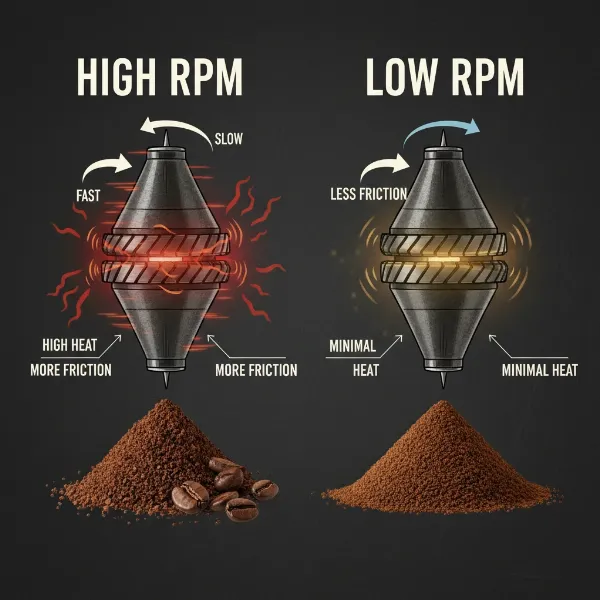 Visual representation of coffee grinder burrs showing heat generation and particle size differences based on RPM
Decoding Flavor: Low vs. High RPM Grinding
The choice of grinding speed is not merely a technical adjustment; it’s a deliberate decision that profoundly shapes the sensory experience of your coffee. Different RPMs unlock distinct flavor profiles, influencing everything from perceived sweetness and acidity to body and clarity.
The Nuances of Low RPM Grinding
When coffee beans are ground at lower RPMs (typically in the range of 200-800 RPM for electric grinders, or roughly 100 turns per minute for manual grinders), the resulting cup often boasts enhanced flavor clarity and a more pronounced acidity. Lower heat generation preserves delicate floral and fruity notes, allowing them to emerge brightly and cleanly. The increased grind uniformity also contributes to a more stable extraction, highlighting the coffee’s natural sweetness and creating a balanced, structured flavor profile that is particularly desirable for specialty coffees with nuanced characteristics. This method promotes a lighter, more refreshing sweetness compared to its high-speed counterpart.
The Characteristics of High RPM Grinding
Grinding at higher RPMs (often exceeding 1000-1500 RPM) can produce a different set of characteristics. For espresso, higher speeds might lead to an upfront sweetness and a heavier body, which some enjoy. However, the increased heat and fines production can come with trade-offs. Acidity may become muted or less distinct, and while sweetness might be present, it can lack complexity, feeling thicker rather than vibrant. The potential for over-extraction from excessive fines can introduce bitterness or a dullness that overshadows the coffee’s inherent qualities. In essence, high-speed grinding prioritizes efficiency but can sacrifice the intricate flavor profile that careful extraction aims to achieve.
The Science Behind the Cup: Extraction and Aromatics
The scientific principles governing RPM and heat in coffee grinding extend beyond simple observation, delving into the chemical composition of the bean and the physical dynamics of extraction.
Preserving Volatile Compounds
Coffee beans contain hundreds of volatile organic compounds (VOCs) that contribute to their complex aroma and flavor. Many of these compounds are sensitive to heat and can degrade or evaporate rapidly when temperatures rise. Low-speed grinding acts as a safeguard, minimizing thermal degradation and ensuring that a higher concentration of these desirable VOCs remains intact in the ground coffee. This preservation directly translates to a more aromatic and flavorful final cup, with notes that are true to the bean’s origin and roast profile.
Achieving Uniform Extraction
Extraction is the process by which hot water dissolves soluble compounds from coffee grounds. Uniform particle size is paramount for consistent extraction. When grind particles vary widely in size, smaller particles (fines) extract quickly, potentially leading to bitterness, while larger particles may under-extract, leaving desirable flavors undeveloped. The more uniform grind achieved at lower RPMs ensures that water interacts with all coffee particles more evenly, leading to a balanced and optimized extraction where sweetness, acidity, and body are harmoniously represented.
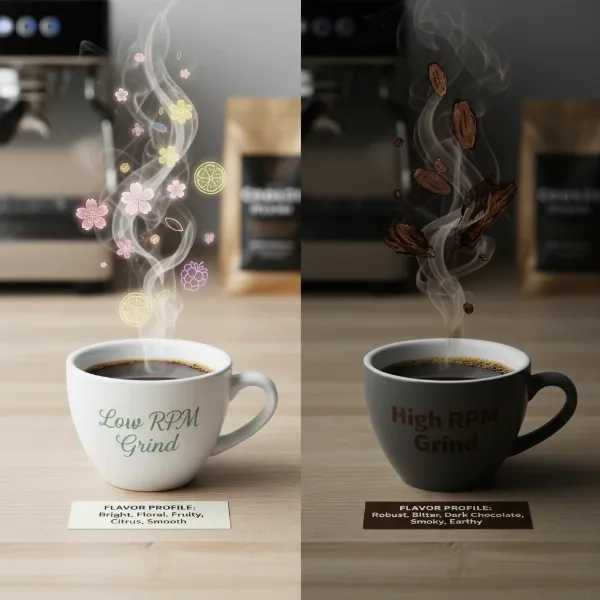 Comparison of two coffee cups, illustrating distinct flavor profiles from low versus high RPM grinding
Temperature’s Broader Impact on Beans and Burrs
Temperature affects not just the grounds but also the beans themselves and the grinder’s components. Coffee beans change density with temperature; higher temperatures can cause beans to expand, potentially leading to inconsistencies in grind size. Furthermore, metal burrs, common in many grinders, expand and contract with temperature fluctuations. In high-volume commercial settings, this can alter the grinder’s calibration over time, leading to inconsistent grind settings throughout the day. While less pronounced in home use, maintaining a consistent grinding chamber temperature is important for repeatable results.
Optimizing Your Grind: Practical Considerations
Understanding the impact of RPM and heat empowers you to make informed decisions that elevate your coffee experience. Whether you’re a home brewer or a professional, a few practical considerations can help you optimize your grind.
Variable RPM Grinders: The Ultimate Control
The advent of grinders with variable RPM settings represents a significant advancement for coffee aficionados. These machines allow users to precisely control burr speed, offering unparalleled flexibility to tailor the grinding process to different coffee beans and brewing methods. For delicate, light-roasted coffees, a lower RPM can preserve their intricate floral and fruity notes. For some darker roasts or specific espresso applications, a slightly higher RPM might be preferred to enhance certain body characteristics. This adaptability transforms the grinder from a static tool into a dynamic instrument for flavor exploration.
The Home Brewer vs. Commercial Cafe Perspective
While the principles of RPM and heat apply universally, their practical implications differ. In a high-volume commercial cafe, grinders operate continuously, generating significant heat that can affect consistency and flavor over many consecutive grinds. Commercial grinders often employ active cooling systems or design features to manage this. For home users, who typically grind smaller batches less frequently, heat buildup is generally less of a concern. However, even at home, paying attention to the grinder’s temperature, especially during back-to-back grinding, can contribute to a more consistent and flavorful result.
Choosing the Right Speed for Your Brew Method
The “optimal” grinding speed isn’t a one-size-fits-all answer; it depends on your brewing method and desired flavor profile.
- For pour-over and filter coffee, where clarity and brightness are often sought, lower RPMs that preserve delicate aromatics and produce a uniform grind are generally favored.
- For espresso, the interplay of speed, heat, and grind consistency is particularly critical. While some espouse very low RPMs for maximum clarity and acidity, others might find a slightly higher, yet still controlled, RPM provides a desirable balance of sweetness and body for certain bean types. Experimentation with variable RPM is key to discovering what works best for your specific beans and espresso machine.
“The pursuit of the perfect cup is a journey of continuous refinement, and understanding the subtle yet powerful influence of grinding speed is a crucial step in unlocking coffee’s true potential.”
Conclusion
The speed at which your coffee grinder operates, and the heat it generates, are not mere technical specifications but fundamental determinants of your coffee’s flavor. Higher RPMs tend to increase heat and fines, potentially dulling delicate aromatics and leading to bitterness, while lower RPMs prioritize grind consistency and temperature stability, preserving the coffee’s inherent sweetness, acidity, and aromatic complexity. Modern advancements, particularly variable RPM grinders, offer unprecedented control, empowering enthusiasts to fine-tune their grind for specific beans and brewing methods. By paying attention to these crucial factors, you can move beyond simply grinding coffee to truly crafting a superior and more flavorful brew. What adjustments will you make to your grinding routine to explore the full spectrum of your coffee’s flavor?
Frequently Asked Questions
Does grinder speed really make a noticeable difference in coffee taste?
Yes, grinder speed significantly impacts coffee taste by affecting heat generation and grind consistency. Lower speeds generally lead to less heat and more uniform particles, preserving delicate flavors like acidity and sweetness, while higher speeds can introduce bitterness and dullness through increased heat and fines.
What is the ideal RPM for a coffee grinder?
There isn’t a single “ideal” RPM; it often depends on the coffee bean and desired flavor profile. Many specialty coffee enthusiasts lean towards lower RPMs (e.g., 300-800 RPM) to maximize flavor clarity and aromatic preservation, especially for delicate beans or filter methods. Espresso often benefits from this range too, though some prefer slightly higher speeds for specific body characteristics.
How does heat from grinding specifically affect coffee flavor?
Heat generated during grinding causes volatile aromatic compounds in the coffee beans to evaporate prematurely. This can lead to a loss of complex flavors, muted acidity, and a less vibrant, sometimes “baked” or dull taste in the final brewed coffee.
Are variable RPM grinders worth the investment for home users?
For serious home coffee enthusiasts seeking to extract the absolute best from their beans, variable RPM grinders can be a worthwhile investment. They offer unparalleled control over grind parameters, allowing for fine-tuning that can significantly enhance flavor and consistency across different coffee origins and brewing methods.
What are “fines” in coffee grinding, and why are fewer fines generally better?
“Fines” are extremely small coffee particles produced during grinding. While some fines are inevitable, an excessive amount (often produced by high RPMs) can lead to over-extraction during brewing, resulting in bitter, astringent flavors and a muddy cup. Fewer fines generally contribute to a cleaner, more balanced, and sweeter extraction.