Have you ever wondered why your coffee tastes different even when using the same beans? The secret often lies in your grind. The precision of your coffee grind profoundly impacts flavor extraction, and at the heart of grind adjustment lie two primary mechanisms: stepped and stepless grinders. Understanding their differences is crucial for anyone looking to elevate their coffee brewing, from the casual homebrewer to the dedicated espresso aficionado. This guide will explore the unique characteristics, advantages, and disadvantages of each type, helping you determine which grinder is the perfect match for your brewing journey.
Understanding Coffee Grinder Adjustment Types
The way you adjust your coffee grinder directly influences the resulting grind size, which in turn dictates how water interacts with the coffee grounds during brewing. A consistent and appropriate grind is paramount for optimal extraction, preventing either under-extraction (sour, weak coffee) or over-extraction (bitter, harsh coffee).
Stepped Grinders: Simplicity and Consistency
|
Our Picks for the Best Coffee grinder in 2026
As an Amazon Associate I earn from qualifying purchases.
|
||
| Num | Product | Action |
|---|---|---|
| 1 | Hamilton Beach Fresh Grind Electric Coffee Grinder for Beans, Spices and More, Stainless Steel Blades, Removable Chamber, Makes up to 12 Cups, Black |

|
| 2 | Wancle Electric Coffee Grinder, Spice Grinder, One Touch Coffee Mill for Beans, Spices and More, with Clean Brush Black |
|
| 3 | Amazon Basics Electric Coffee Grinder, Coffee Bean and Spice Grinder, With Heavy-Duty Stainless Steel Grind Blades |
|
| 4 | SHARDOR Professional Conical Burr Coffee Grinder, Coffee Bean Grinder with 48 Grind Settings for Espresso, Drip & French Press, Upgraded Anti-Static Technology, Precision Timer, Stainless Steel |
|
| 5 | BLACK+DECKER One Touch Coffee Grinder, 2/3 Cup Coffee Bean Capacity, Spice Grinder, One Touch Push-Button Control -150 Watts -Stainless Steel Blades |
|
| 6 | OXO Brew Conical Burr Coffee Grinder - Silver, Stainless Steel Burrs, One-Touch Automatic Smart Grind |
|
| 7 | Cuisinart Coffee Grinder, One Touch Control Coffee Bean Grinder with Stainless Steel Bowl and Blades, 2.5 oz/70g Capacity Enough for 12 Cups, On/Off Switch with Safety Interlock, DCG-20BKN, Black |
|
| 8 | Hamilton Beach Custom Grind Electric Coffee Grinder for 4-14 Cups, One-Press Hand-Free Operation with Auto Shutoff, Removable Grinding Bowl For Easy Pour and Clean, Stainless Steel (80406) |
|
| 9 | Automatic Coffee Machine, 20-Bar Pressure Espresso Maker with Built-in Grinder, 15-Precision Settings, One-Touch Latte & Cappuccino System, Smart Self-Cleaning |
|
| 10 | Cuisinart Coffee Grinder, Electric One-Touch Automatic Burr Coffee Grinder with 18-Position Grind Selector, Cup Size Selector for 4 – 18 Cups, DBM-8P1, Black Stainless |
|
Stepped grinders feature preset, fixed grind settings, often marked by “clicks” or numbered increments on a dial or collar. Each click moves the burrs a specific, discrete distance, resulting in a distinct grind size. This design makes them incredibly intuitive and user-friendly, especially for those new to coffee brewing.
These grinders are celebrated for their ease of use and the ability to consistently return to a specific grind setting. If you frequently switch between brewing methods—say, from a coarse French press grind to a medium pour-over grind—a stepped grinder allows you to easily recall and select your preferred setting without extensive trial and error. Their straightforward design often makes them more affordable and requires less maintenance compared to their stepless counterparts. However, the limitation of stepped grinders lies in these very steps; if the perfect grind size for a particular bean or brewing method falls between two preset steps, you might struggle to achieve the ideal extraction. This can be particularly challenging for espresso, which demands extremely precise micro-adjustments to dial in the perfect shot.
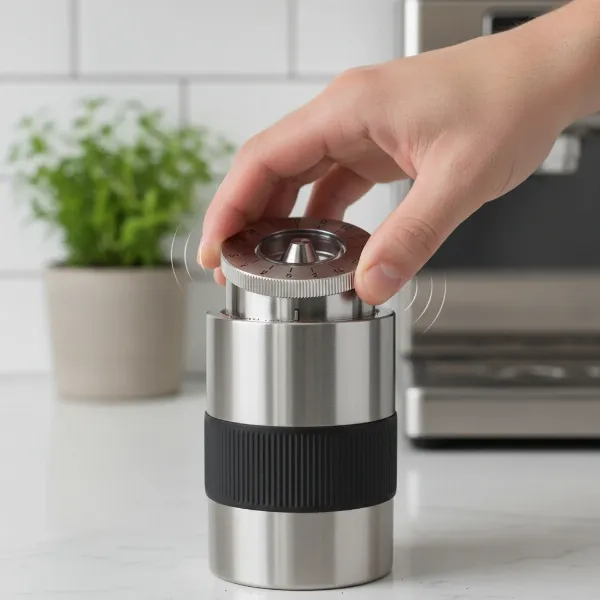 Close-up of a stepped coffee grinder dial with numbered settings for different grind sizes.
Stepless Grinders: Precision and Control
In contrast, stepless grinders offer continuous, infinite grind size adjustments. Instead of fixed clicks, these grinders allow you to rotate a collar or knob through an unbroken range, providing micrometric control over the burr distance. This means you can incrementally fine-tune your grind to an almost limitless degree.
The primary advantage of stepless grinders is their unparalleled precision. This level of granular control is invaluable for experienced baristas and coffee enthusiasts who seek to meticulously dial in their espresso shots or extract nuanced flavors from specific beans. With infinite adjustability, you can achieve the exact grind necessary to optimize extraction, balance crema, and highlight the subtle flavor notes in your coffee. However, this precision comes with a learning curve. Without preset reference points, it can be more challenging to find and replicate a specific grind setting, especially when switching between vastly different brewing methods. Stepless grinders are also generally more expensive and require a greater understanding of grind mechanics to master.
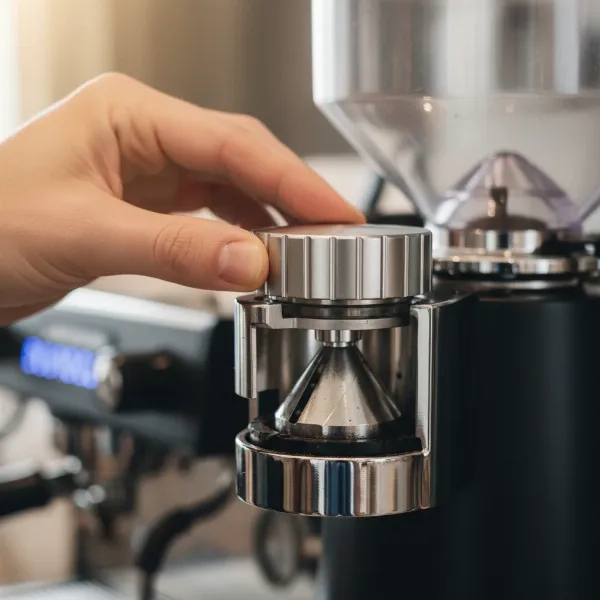 Hand adjusting a stepless coffee grinder's collar for continuous, precise grind size control.
Stepped vs. Stepless Grinders: A Direct Comparison
| Feature | Stepped Grinders | Stepless Grinders |
|---|---|---|
| Grind Precision | Limited to preset intervals | Infinite, micrometric adjustments |
| Ease of Use | Very user-friendly, easy to learn | Requires more experience to master |
| Ideal For | Beginners, general home use, multiple brew methods | Espresso enthusiasts, advanced users, fine-tuning |
| Cost | Generally more affordable | Typically more expensive |
| Switching Methods | Easy with repeatable, marked settings | Challenging to replicate settings for diverse methods |
Factors to Consider When Choosing Your Grinder
Selecting the right grinder involves more than just understanding the mechanisms; it requires an honest assessment of your brewing habits, experience, and priorities.
Your Brewing Method(s)
The type of coffee you typically brew is a major deciding factor. If espresso is your passion, the precise nature of a stepless grinder often proves indispensable. Espresso brewing is incredibly sensitive to grind size; even a minute adjustment can drastically alter extraction time and flavor profile. For methods like French press, pour-over, or drip coffee, which are more forgiving, a stepped grinder usually offers sufficient control. If you enjoy experimenting with a variety of brew methods, a stepped grinder with clearly marked settings might offer more convenience, though some modern stepped grinders feature very small “micro-steps” that provide greater versatility.
Your Experience Level
For beginners, the simplicity and intuitive nature of a stepped grinder can make the learning process less daunting. You can easily select a setting for your chosen brew method and achieve consistent results without the frustration of endless adjustments. Experienced coffee enthusiasts and professionals, however, often crave the control a stepless grinder provides. They are willing to invest the time and effort to learn how to manipulate the infinite settings to extract the absolute best from their beans.
Your Budget
Generally, stepped grinders tend to be more budget-friendly. This makes them an excellent entry point into the world of quality home grinding. Stepless grinders, with their advanced engineering for precision, typically come with a higher price tag. Consider your investment level and how much you’re willing to spend to achieve your desired level of control and flavor refinement.
Frequency of Switching Brew Methods
Do you stick to one go-to brewing method, or do you frequently jump between espresso, pour-over, and French press? If you’re a multi-method brewer, the repeatable settings of a stepped grinder can be a significant advantage, saving you time and coffee as you easily return to your saved preferences. For stepless grinders, switching between vastly different grind sizes and then finding your way back to a previous setting for another method can be a painstaking process due to the lack of clear markers. If you primarily brew one type of coffee, the stepless option allows for ultimate focus on that single preparation.
Top Picks: Finding the Right Grinder for You
Choosing the “best” grinder isn’t about universal superiority but about finding the ideal tool for your specific needs.
Best for Beginners & Multiple Brew Methods (Stepped)
If you’re just starting your coffee journey, value simplicity, and brew various coffee styles, a quality stepped grinder is an excellent choice. These grinders offer reliability and consistency across their preset range, making it easy to switch from a French press to a pour-over grind with confidence. They provide a solid foundation for understanding how grind size impacts flavor without the steep learning curve of infinite adjustments. Many popular home grinders, both manual and electric, fall into this category, offering great value and performance.
Best for Espresso Enthusiasts (Stepless)
For the dedicated espresso lover or the advanced home barista who prioritizes ultimate control and precision, a stepless grinder is often the preferred tool. The ability to make minute adjustments allows you to perfectly dial in your espresso, compensating for variations in beans, roast levels, and environmental factors. This level of fine-tuning can unlock exceptional flavor clarity and a perfectly balanced shot. While they require more attention and experience to master, the reward is an unparalleled ability to craft your ideal espresso.
Conclusion
The choice between stepped and stepless coffee grinders ultimately boils down to a balance between convenience and control. Stepped grinders offer user-friendliness and repeatability, making them perfect for beginners and those who frequently change brewing methods. Stepless grinders, on the other hand, provide unmatched precision and are the go-to for espresso aficionados and experienced users who demand meticulous control over their coffee extraction. Whichever you choose, remember that a quality burr grinder is the most impactful investment you can make in your coffee setup. Consider your brewing habits, experience level, and budget to find the grinder that empowers you to brew your best cup every time. What kind of coffee brewing experience are you seeking to create?
Frequently Asked Questions
Are stepped grinders suitable for espresso?
While stepless grinders offer more granular control for espresso, some high-quality stepped grinders feature very small “micro-steps” that can provide sufficient precision for dialing in espresso. For beginners, a stepped grinder can still produce enjoyable espresso, though fine-tuning may be more challenging than with a stepless model.
Can I easily switch between espresso and pour-over settings on a stepless grinder?
Switching between vastly different grind sizes, like espresso and pour-over, on a stepless grinder can be more challenging than on a stepped one. Without marked reference points, it requires more effort and trial-and-error to find and return to previous settings. Stepped grinders excel in this scenario due to their distinct, repeatable settings.
Do professional baristas always use stepless grinders?
Many professional baristas and high-end cafes prefer stepless grinders due to the unparalleled precision they offer for dialing in espresso, which is critical in a commercial setting. However, the specific choice can also depend on the grinder’s quality, the type of coffee served, and the baristas’ personal preferences.
What is “dialing in” coffee?
“Dialing in” refers to the process of making small adjustments to your grinder’s settings, dose, and other brewing parameters to achieve the optimal extraction and flavor from your coffee beans. This often involves trial and error to find the “sweet spot” where the coffee tastes best for a specific brewing method.