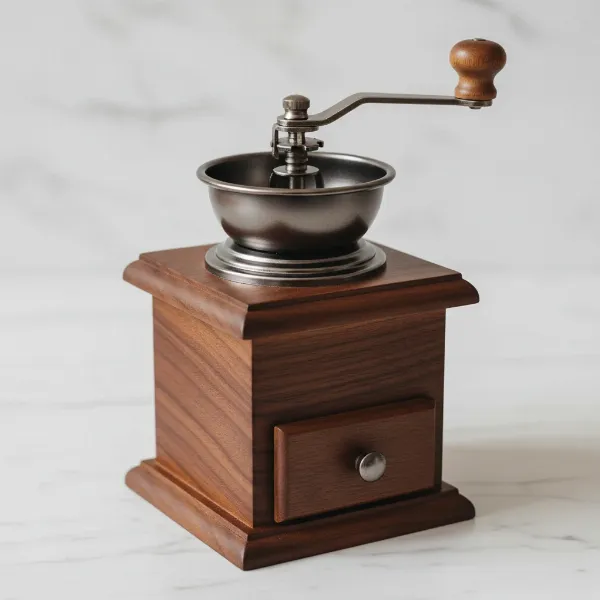
Embarking on the journey of home coffee brewing often leads to a crucial realization: the grinder is as vital as the beans themselves. Many start with a basic propeller grinder, assuming a uniform grind, only to discover a world of inconsistency. As a coffee technician with over a decade of experience, I’ve delved deep into the mechanics and artistry of coffee grinding. This guide will clarify the fundamental differences between propeller and burr grinders, focusing on the critical aspect of grind consistency and how it shapes your daily brew.
The Different Types of Coffee Grinders
The foundation of a great cup of coffee lies in the evenness of your grind. Different grinding mechanisms achieve this with varying degrees of success, directly influencing the flavor and quality of your brew.
Propeller (Blade) Grinders
Propeller grinders, often referred to as blade grinders, operate much like blenders. A spinning blade at high speed chops and shatters coffee beans into grounds.
- Pros: These grinders are typically very inexpensive and compact, making them an accessible entry point for many home brewers. They are also straightforward to operate with a simple pulse button.
- Cons: The most significant drawback is their inability to produce a consistent grind. The blades pulverize beans unevenly, resulting in a mix of fine dust and large chunks. This process also generates considerable heat through friction, which can “cook” the coffee beans and degrade delicate flavors and aromas even before brewing begins. The lack of control over grind size makes it challenging to achieve optimal extraction.
- Best for: While not ideal for coffee, their affordability and simplicity make them suitable for occasional users who prioritize convenience over quality, or for grinding spices where consistency is less critical.
|
Our Picks for the Best Coffee grinder in 2026
As an Amazon Associate I earn from qualifying purchases.
|
||
| Num | Product | Action |
|---|---|---|
| 1 | Hamilton Beach Fresh Grind Electric Coffee Grinder for Beans, Spices and More, Stainless Steel Blades, Removable Chamber, Makes up to 12 Cups, Black |

|
| 2 | Cuisinart Coffee Grinder, One Touch Control Coffee Bean Grinder with Stainless Steel Bowl and Blades, 2.5 oz/70g Capacity Enough for 12 Cups, On/Off Switch with Safety Interlock, DCG-20BKN, Black |
|
| 3 | Wancle Electric Coffee Grinder, Spice Grinder, One Touch Coffee Mill for Beans, Spices and More, with Clean Brush Black |
|
| 4 | SHARDOR Professional Conical Burr Coffee Grinder, Coffee Bean Grinder with 48 Grind Settings for Espresso, Drip & French Press, Upgraded Anti-Static Technology, Precision Timer, Stainless Steel |
|
| 5 | BLACK+DECKER One Touch Coffee Grinder, 2/3 Cup Coffee Bean Capacity, Spice Grinder, One Touch Push-Button Control -150 Watts -Stainless Steel Blades |
|
| 6 | Automatic Coffee Machine, 20-Bar Pressure Espresso Maker with Built-in Grinder, 15-Precision Settings, One-Touch Latte & Cappuccino System, Smart Self-Cleaning |
|
| 7 | Hamilton Beach Custom Grind Electric Coffee Grinder for 4-14 Cups, One-Press Hand-Free Operation with Auto Shutoff, Removable Grinding Bowl For Easy Pour and Clean, Stainless Steel (80406) |
|
| 8 | Cuisinart Coffee Grinder, Electric One-Touch Automatic Burr Coffee Grinder with 18-Position Grind Selector, Cup Size Selector for 4 – 18 Cups, DBM-8P1, Black Stainless |
|
| 9 | Amazon Basics Electric Coffee Grinder, Coffee Bean and Spice Grinder, With Heavy-Duty Stainless Steel Grind Blades |
|
| 10 | OXO Brew Conical Burr Coffee Grinder - Silver, Stainless Steel Burrs, One-Touch Automatic Smart Grind |
|
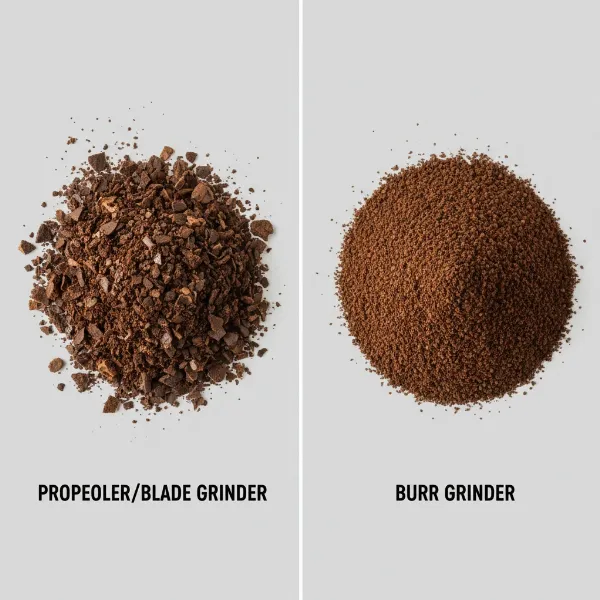 Visual comparison showing inconsistent coffee grounds from a blade grinder next to consistent grounds from a burr grinder.
Burr Grinders
Burr grinders represent a significant leap in coffee grinding technology. Instead of chopping, they crush coffee beans between two abrasive surfaces, known as burrs. This method ensures a far more uniform particle size, which is paramount for consistent extraction and superior flavor.
- Pros: Burr grinders deliver a highly consistent grind, which is crucial for balanced coffee extraction. They offer adjustable grind settings, allowing precise control over particle size to suit various brewing methods. By crushing rather than chopping, they generate less heat, preserving the coffee’s aromatic oils and flavor integrity.
- Cons: These machines are generally more expensive than blade grinders and can be larger and heavier, requiring more counter space.
- Best for: Burr grinders are indispensable for anyone serious about brewing high-quality coffee at home, from daily drip coffee drinkers to espresso enthusiasts.
Conical Burr Grinders
Within the category of burr grinders, two main types exist: conical and flat. Conical burr grinders feature a cone-shaped inner burr that rotates inside a hollow, stationary outer burr.
- Pros: Conical burr grinders are often quieter and produce less heat during operation compared to flat burrs, due to their slower rotational speeds and gravity-assisted bean feeding. They are also typically more affordable than high-end flat burr models, offering excellent consistency for a wide range of brewing methods. Many entry-level and mid-range burr grinders utilize conical burrs effectively.
- Cons: While highly consistent, some high-end flat burr grinders may surpass conical burrs in terms of absolute grind uniformity, especially for very fine espresso grinds.
- Best for: These are an excellent choice for general home brewing, including drip, pour-over, and French press, and many models are also capable of grinding for espresso.
Flat Burr Grinders
Flat burr grinders consist of two parallel, ring-shaped burrs with cutting teeth. One burr is stationary, and the other rotates, grinding beans as they pass between the surfaces.
- Pros: Flat burr grinders are renowned for producing exceptionally uniform particle sizes, particularly when designed with high precision. This consistency translates to a brighter, cleaner cup profile with distinct flavor separation, making them favored by specialty coffee enthusiasts for pour-over and espresso, where clarity is prized. Premium models often incorporate robust cooling systems to manage heat.
- Cons: High-end flat burr grinders can be significantly more expensive. They may also be louder and, if not properly ventilated, can generate more heat than conical burrs, potentially impacting flavor over prolonged use. Achieving perfect alignment can also be more challenging in manufacturing.
- Best for: Flat burr grinders are often the choice for professional baristas and home users who demand the highest level of grind precision for espresso, pour-over, and other methods where subtle flavor nuances are critical.
Comparison Table: Propeller vs. Burr Grinders
Understanding the fundamental differences at a glance can help clarify your choice:
| Feature | Propeller (Blade) Grinder | Burr Grinder (Conical/Flat) |
|---|---|---|
| Grind Consistency | Very Poor (uneven, fines & boulders) | Excellent (uniform particle size) |
| Price | Low | Medium to High |
| Heat Generation | High (can degrade flavor) | Low (preserves flavor) |
| Flavor Impact | Negative (bitter, muddy) | Positive (balanced, clear, aromatic) |
| Control | Minimal (pulse only) | High (adjustable grind settings) |
| Best Use | Spices, very casual coffee | All coffee brewing methods |
Key Factors When Choosing Your Coffee Grinder
Selecting the right coffee grinder goes beyond just choosing between blade and burr. Several factors contribute to a grinder’s performance and suitability for your brewing needs.
Grinder Type: Blade vs. Burr
The initial and most crucial decision is between a blade (propeller) and a burr grinder. For any discernible quality in your coffee, a burr grinder is the undeniable choice. Blade grinders simply cannot produce the uniformity required for even extraction, leading to a compromise in taste.
Burr Type: Conical vs. Flat
Once committed to a burr grinder, you’ll encounter the conical vs. flat burr debate. While high-quality models of both types can yield excellent results, flat burrs are often lauded for superior consistency and flavor clarity, especially in finer grinds for espresso and pour-over. Conical burrs offer a good balance of consistency, quieter operation, and often a more accessible price point. Your preferred brewing method and budget will largely dictate this choice.
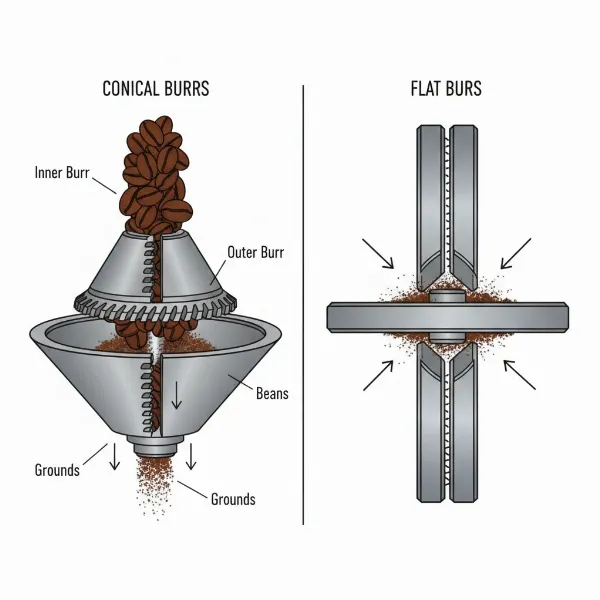 Close-up comparison of conical and flat coffee grinder burrs, highlighting their structural differences.
Grind Settings & Adjustability
A good burr grinder offers a wide range of grind settings. This adjustability is vital because different brewing methods require specific grind sizes. Espresso needs an ultra-fine grind, pour-over a medium grind, and French press a coarse grind. Look for grinders with precise, easily adjustable settings, whether stepped (click-based) or stepless (infinite adjustments), to dial in the perfect grind for your chosen brew.
Burr Material
Burrs are typically made from stainless steel or ceramic. Stainless steel burrs are durable and hold a sharp edge, commonly found in many quality grinders. Ceramic burrs are harder and can retain sharpness longer but are more brittle and susceptible to chipping. Both materials can deliver excellent performance, with many manufacturers opting for metal for its resilience.
Heat Management
Heat is an enemy of fresh coffee flavor. Excessive heat generated during grinding can prematurely release volatile aromatic compounds. Burr grinders generally produce less heat than blade grinders. Look for models with efficient motor designs and good ventilation to minimize heat transfer to the coffee grounds, especially for larger grinding capacities.
Noise Level
Coffee grinding can be a noisy affair. If you’re an early riser in a household of light sleepers, the noise level might be a significant consideration. Conical burr grinders often operate more quietly due to their lower RPMs, while some flat burr models incorporate noise reduction technology.
Capacity & Retention
Consider how much coffee you typically grind at once. Larger hoppers are convenient for frequent brewing, but single-dosing grinders minimize “retention” – old grounds left in the machine – ensuring every batch is as fresh as possible. Low retention designs are critical for maximizing flavor and avoiding stale coffee contamination.
Cleaning and Maintenance
Regular cleaning is essential for maintaining optimal grind quality and flavor. Coffee oils and fine particles accumulate over time, leading to rancid tastes. Look for grinders that are easy to disassemble and clean, with accessible burrs and minimal crevices where grounds can get trapped.
Top Picks: Our Recommended Coffee Grinders
Based on extensive testing and expert consensus, here are some top-performing burr grinders that stand out for their consistency and overall quality, catering to different needs and budgets.
Breville Smart Grinder Pro – The Versatile Performer
This popular electric burr grinder is a favorite for its wide range of 60 grind settings and intuitive digital interface. It consistently delivers excellent grinds for various brewing methods, from espresso to pour-over, though it can struggle slightly with coarser French press grinds. Its user-friendly design and timed dosing make it a great all-rounder for home baristas seeking control and convenience.
Baratza Encore – The Reliable Entry-Level Champion
Often recommended as the go-to entry-level burr grinder, the Baratza Encore offers exceptional grind consistency for its price point. While it might be a bit louder and its body mostly plastic, its durable conical burrs and simple, reliable operation make it a fantastic upgrade from any blade grinder. It’s particularly strong for pour-over and drip coffee and is a solid foundation for those looking to explore better coffee at home.
Fellow Ode Gen 2 Coffee Grinder – The Pour-Over Perfectionist
Designed with pour-over coffee in mind, the Fellow Ode Gen 2 features vertically oriented flat burrs and advanced anti-static technology, resulting in remarkably consistent grounds with minimal fines and boulders. It boasts a sleek, modern design, quiet operation, and a useful grind chart under the lid. While pricier and less suited for espresso due to its grind range, it excels at clarity and balanced flavor for filter coffee methods.
Conclusion
The pursuit of exceptional coffee at home invariably leads to the grinder. The stark contrast between a propeller (blade) grinder’s inconsistent chopping and a burr grinder’s precise crushing directly translates into the quality of your brew. Investing in a burr coffee grinder, whether conical or flat, is arguably the single most impactful upgrade you can make to your coffee ritual. It ensures grind consistency, which is the bedrock of even extraction, unlocking the full, nuanced flavors your coffee beans have to offer.
By understanding the differences and considering factors like burr type, adjustability, and maintenance, you can select a Coffee Grinder that will elevate your daily cup from ordinary to extraordinary. Are you ready to taste the true potential of your coffee beans?
Frequently Asked Questions
Why is grind consistency so important for coffee?
Grind consistency is crucial because it ensures that all coffee particles extract at roughly the same rate when brewed. An inconsistent grind, with varying particle sizes, leads to both over-extraction (bitterness from tiny fines) and under-extraction (sourness from large chunks) occurring simultaneously, resulting in an unbalanced, muddy, or otherwise undesirable flavor in your cup.
Can I improve the consistency of a blade grinder?
While blade grinders inherently produce inconsistent grinds, some techniques can slightly mitigate this. Grinding in short pulses, shaking the grinder between pulses, or sifting the grounds afterwards can help. However, these methods are labor-intensive and will never match the uniformity achieved by a dedicated burr grinder.
Are manual burr grinders as good as electric ones?
Many high-quality manual burr grinders can produce excellent grind consistency, often on par with or even surpassing electric models, especially in portable designs. They offer precise adjustment and preserve flavor by generating minimal heat. The main trade-off is the manual effort required, which makes them less ideal for grinding large quantities of coffee.
How often should I clean my coffee grinder?
For optimal performance and flavor, you should brush out your burr grinder every few days to remove loose grounds and oils. A deeper clean, involving disassembling the burrs and wiping away accumulated coffee residue, is recommended monthly. Regular cleaning prevents stale coffee oils from tainting the flavor of fresh beans.