Achieving the perfect cup of coffee begins with a consistent grind. Yet, many coffee enthusiasts encounter the frustrating problem of inconsistent particle size, which can lead to a muddled, unbalanced, and truly disappointing brew. From overly fine “fines” that cause bitterness to large “boulders” that result in under-extraction, an uneven grind prevents your coffee from reaching its full flavor potential. This comprehensive guide will explore the common culprits behind inconsistent particle size and provide actionable troubleshooting steps to help you restore precision to your coffee grinding process and elevate your daily brew.
Understanding Your Coffee Grinder: Types and Their Consistency
The type of coffee grinder you use significantly influences the consistency of your coffee grounds. Recognizing these differences is the first step in diagnosing and resolving particle size issues.
Hand Grinders
|
Our Picks for the Best Coffee grinder in 2026
As an Amazon Associate I earn from qualifying purchases.
|
||
| Num | Product | Action |
|---|---|---|
| 1 | Cuisinart Coffee Grinder, Electric One-Touch Automatic Burr Coffee Grinder with 18-Position Grind Selector, Cup Size Selector for 4 – 18 Cups, DBM-8P1, Black Stainless |

|
| 2 | BLACK+DECKER One Touch Coffee Grinder, 2/3 Cup Coffee Bean Capacity, Spice Grinder, One Touch Push-Button Control -150 Watts -Stainless Steel Blades |
|
| 3 | Cuisinart Coffee Grinder, One Touch Control Coffee Bean Grinder with Stainless Steel Bowl and Blades, 2.5 oz/70g Capacity Enough for 12 Cups, On/Off Switch with Safety Interlock, DCG-20BKN, Black |
|
| 4 | Hamilton Beach Fresh Grind Electric Coffee Grinder for Beans, Spices and More, Stainless Steel Blades, Removable Chamber, Makes up to 12 Cups, Black |
|
| 5 | OXO Brew Conical Burr Coffee Grinder - Silver, Stainless Steel Burrs, One-Touch Automatic Smart Grind |
|
| 6 | Hamilton Beach Custom Grind Electric Coffee Grinder for 4-14 Cups, One-Press Hand-Free Operation with Auto Shutoff, Removable Grinding Bowl For Easy Pour and Clean, Stainless Steel (80406) |
|
| 7 | SHARDOR Professional Conical Burr Coffee Grinder, Coffee Bean Grinder with 48 Grind Settings for Espresso, Drip & French Press, Upgraded Anti-Static Technology, Precision Timer, Stainless Steel |
|
| 8 | Wancle Electric Coffee Grinder, Spice Grinder, One Touch Coffee Mill for Beans, Spices and More, with Clean Brush Black |
|
| 9 | Automatic Coffee Machine, 20-Bar Pressure Espresso Maker with Built-in Grinder, 15-Precision Settings, One-Touch Latte & Cappuccino System, Smart Self-Cleaning |
|
| 10 | Amazon Basics Electric Coffee Grinder, Coffee Bean and Spice Grinder, With Heavy-Duty Stainless Steel Grind Blades |
|
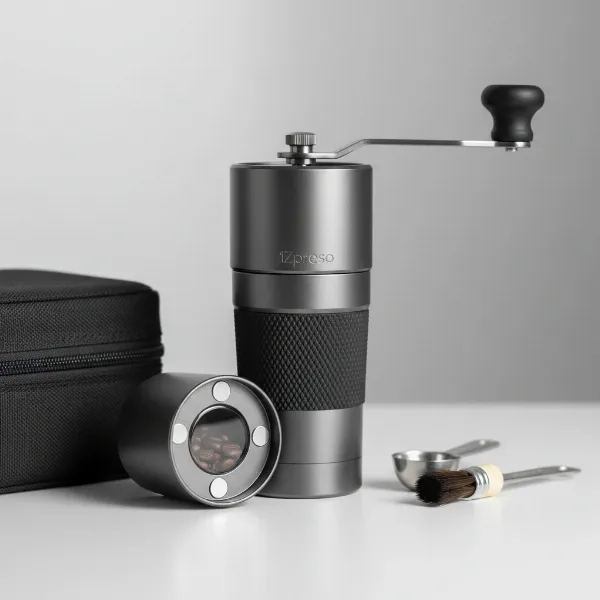
Hand grinders, typically equipped with conical burrs, offer excellent grind consistency, often rivaling electric burr grinders at a fraction of the cost. They are portable, quiet, and allow for precise control over grind settings. However, they require manual effort and can be slower, making them suitable for smaller batches or those who appreciate the ritual of manual preparation. Their consistency can suffer if internal parts like plastic inserts or the burr assembly become misaligned.
Blade Grinders
Blade grinders are often the entry-level choice due to their affordability and ease of use. However, they don’t grind coffee; they chop it using a spinning blade. This method inevitably produces an extremely inconsistent particle size, with a wide range from coarse chunks to fine dust, regardless of how long you run them. The heat generated by the blades can also negatively impact coffee flavor. For truly consistent results, blade grinders are generally not recommended.
Electric Burr Grinders (Disc or Conical)
Electric burr grinders are the gold standard for achieving consistent particle size. They use two abrasive surfaces (burrs) to crush coffee beans into uniform particles.
- Conical Burr Grinders: Feature two cone-shaped burrs that fit inside each other, known for their efficiency, quieter operation, and fewer fines. They are excellent for a wide range of grind sizes.
- Flat Burr Grinders: Utilize two parallel, ring-shaped burrs. They often produce a more uniform grind distribution with a slightly different flavor profile, sometimes perceived as more intense and clean.
Both types offer adjustable settings to dial in the perfect grind for various brewing methods, making them ideal for serious coffee lovers.
Coffee Grinder Comparison: Consistency at a Glance
Understanding how different grinder types perform in terms of consistency is crucial for managing expectations and identifying potential issues.
| Feature | Hand Grinder | Blade Grinder | Electric Burr Grinder (Conical/Flat) |
|---|---|---|---|
| Grind Consistency | Very good | Poor (Chopping action) | Excellent |
| Price | Low – Medium | Very Low | Medium – High |
| Noise Level | Very Quiet | Loud | Moderate |
| Durability | High (Burrs last) | Low (Blades dull) | Medium – High (Burrs last) |
| Portability | High | Low | Low |
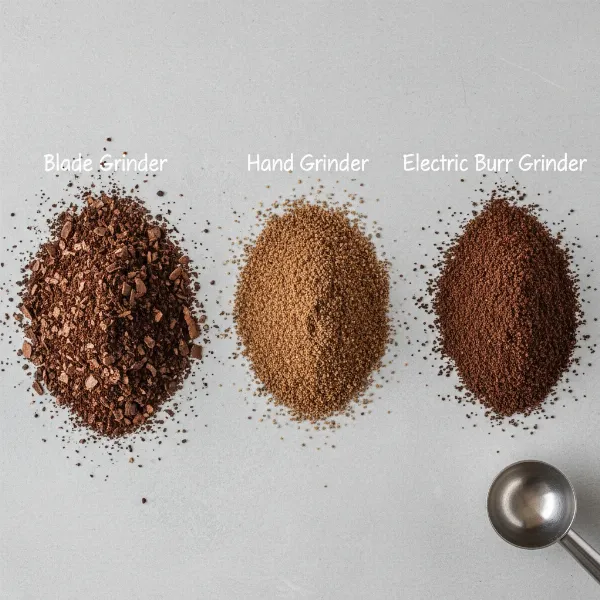 Visual comparison of coffee grind consistency from blade, hand, and electric burr grinders.
Factors Affecting Grind Consistency
Several elements can contribute to or detract from your Coffee Grinder’s ability to produce consistent particle sizes. Understanding these factors is key to effective troubleshooting.
Grinder Type
As highlighted, the fundamental design of a grinder plays the most significant role. Blade grinders are inherently inconsistent, while burr grinders are designed for precision. If you are using a blade grinder and seeking consistency, upgrading to a burr grinder is often the most impactful solution.
Burr Material and Wear
The quality and condition of your burrs are paramount. Burrs are typically made from steel or ceramic. Over time, burrs can dull, chip, or become worn, which severely compromises their ability to create uniform particles. Dull burrs will produce more fines and larger chunks, leading to a less predictable and less flavorful extraction. Regularly inspecting your burrs for signs of wear is a critical maintenance step.
Cleanliness and Maintenance
Coffee beans contain oils that, over time, build up on the burrs and internal components of your grinder. This residue can gum up the grinding mechanism, create blockages, and prevent beans from feeding smoothly. A dirty grinder will struggle to maintain consistent spacing between the burrs, leading to inconsistent particle size. Regular cleaning is non-negotiable for optimal performance.
Bean Freshness
The age and freshness of your coffee beans significantly impact grind consistency. Older, stale beans tend to be drier and more brittle than fresh beans. This brittleness can cause them to shatter unevenly during grinding, resulting in a higher proportion of fines and larger fragments. Always use freshly roasted coffee and grind it just before brewing for the best results.
Grinder Calibration and Alignment
For burr grinders, precise calibration and alignment of the burrs are essential. If the burrs are not perfectly parallel or properly centered, the gap between them will be uneven, causing some particles to be ground finer and others coarser. This issue can stem from improper assembly after cleaning, loose components, or manufacturing defects. Many grinders have mechanisms that, if damaged or incorrectly installed, can affect alignment.
Bean Level in Hopper
The amount of coffee beans in your grinder’s hopper can subtly influence consistency, particularly in certain models. Many grinders rely on the weight of the beans in the hopper to feed them consistently into the burrs. When the hopper is nearly empty, this downward pressure decreases, potentially leading to a less consistent feed and a coarser grind. For critical brewing methods like espresso, it’s often recommended to grind single doses or ensure a consistent bean level.
Troubleshooting Inconsistent Particle Size: Step-by-Step Solutions
If you’re experiencing inconsistent particle size, follow these steps to diagnose and resolve the issue.
Step 1: Assess Your Coffee Beans
Start with the basics. The quality and freshness of your beans are foundational to a good grind.
- Check Roast Date: Ensure your coffee beans were roasted recently, ideally within 2-4 weeks. Stale beans are a common cause of uneven grinding.
- Storage: Store whole beans in an airtight, opaque container in a cool, dark place. Avoid storing large quantities in the grinder’s hopper, as hoppers are rarely airtight.
- Pre-Grind Flush: If your grinder has been idle for several hours, grind and discard a small amount (a few grams) of beans before grinding your dose. This flushes out any stale grounds retained from previous sessions.
- Hopper Level: For optimal performance, try to keep a consistent amount of beans in the hopper, or consider single-dosing your beans if your grinder supports it well.
Step 2: Clean Your Grinder Thoroughly
Coffee oils and fine particles accumulate over time, obstructing the burrs and internal chute, which is a leading cause of inconsistency.
- Disassemble: Unplug your grinder. Consult your manual for instructions on how to safely disassemble the burr chamber.
- Brush Away Grounds: Use a stiff brush (often provided with the grinder) or a vacuum cleaner with a narrow attachment to remove all loose coffee grounds.
- Remove Oils: Use a grinder-specific cleaning tablet (like Grindz) or a small amount of uncooked rice (use sparingly and with caution, as it can stress some motors) to clear stubborn oils. Follow product instructions carefully.
- Wipe Down: Use a damp cloth to wipe down any accessible surfaces, ensuring they are completely dry before reassembly.
“A dirty grinder is a sabotaged grinder. Residue buildup silently degrades consistency, no matter how good your burrs are.” – Admin, Coffeegrinderchoice.com
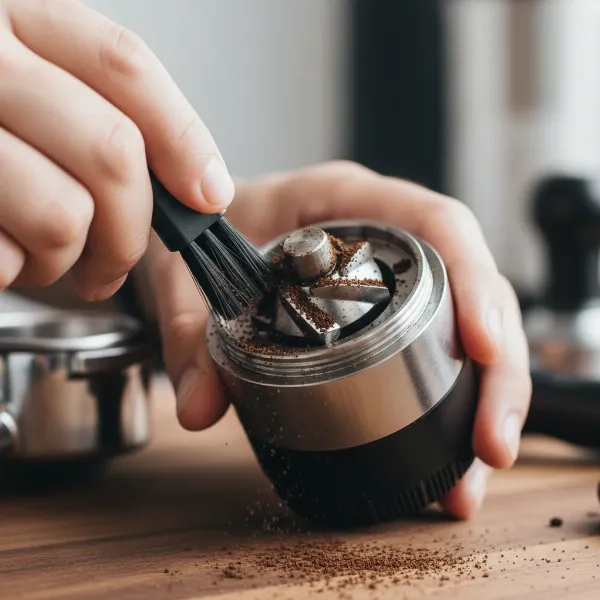 Person cleaning a coffee grinder burr with a brush, removing old coffee oils and grounds.
Step 3: Check and Align Your Burrs
Misalignment or wear in the burrs is a critical issue for consistency, especially in burr grinders.
- Inspection: Once cleaned, carefully inspect the burrs for any visible signs of wear, chips, or dullness. If burrs appear significantly worn, they may need replacement.
- Hand Grinder Specifics: For hand grinders, check the plastic inserts in the inner burr. Ensure they are pressed fully into the ceramic, preventing the burr from sitting crookedly on the axle. Reassemble, ensuring the burr sits straight and the thumbnut is tightened securely. If still crooked, try rotating the inner burr 180 degrees and re-tightening.
- Electric Burr Grinder Alignment:
- Loose Components: Check for any loose screws, springs, or adjustment tabs in the burr holder or adjustment ring. Any broken or missing tabs can disrupt alignment.
- Reassembly: When reassembling, ensure all components snap or screw securely into place according to the manufacturer’s guidelines. Improper reassembly is a common cause of new alignment issues.
- Professional Alignment: If you suspect severe misalignment that cannot be fixed by cleaning or reassembly, some high-end grinders can be professionally calibrated.
Step 4: Optimize Your Grinding Technique (Especially for Blade Grinders)
While a burr grinder is ideal, if you’re using a blade grinder, these techniques can help mitigate inconsistency.
- Pulse Grinding: Instead of running the grinder continuously, use short, controlled pulses. This helps to break down beans more gradually and reduces heat buildup.
- Shake While Grinding: Gently shake the blade grinder while pulsing. This helps circulate the beans more evenly, ensuring all particles get exposed to the blades more uniformly.
Step 5: Monitor Your Dose and “Dial In”
Even with a well-maintained grinder, achieving consistent extraction requires precise control over other variables.
- Weigh Your Dose: Always use a digital scale to weigh your whole beans before grinding. Inconsistent coffee mass will lead to inconsistent extraction, even with a perfect grind.
- Adjust Grind Setting Incrementally: If your brew tastes sour (under-extracted), your grind is likely too coarse; adjust slightly finer. If it tastes bitter (over-extracted), your grind is too fine; adjust slightly coarser. Make small adjustments and test the results over several brews, keeping other variables like water temperature and brew time constant. This process is known as “dialing in.”
Step 6: Consider Burr Replacement or Grinder Upgrade
If you’ve followed all troubleshooting steps and still experience significant inconsistency, it might be time for more substantial action.
- Burr Replacement: Burrs have a lifespan. For home grinders, burrs might last several years, but for frequent use or commercial settings, they may need replacement more often. Check your grinder’s manual or manufacturer’s website for replacement burrs.
- Grinder Upgrade: If you are using a blade grinder and consistency is your priority, investing in a quality burr grinder (even a good manual one) will be the most significant improvement you can make to your coffee quality. The difference is often transformative.
Conclusion
Inconsistent particle size is a common obstacle to brewing exceptional coffee, yet it’s a problem that can often be resolved with careful attention and a systematic approach. By ensuring your coffee beans are fresh, your grinder is impeccably clean, its burrs are properly aligned, and your technique is precise, you can dramatically improve the consistency of your grind. Whether it’s a simple cleaning or a necessary upgrade, investing time in your grinder’s performance will unlock the true potential of your coffee, delivering a consistently delicious and balanced cup every time. What improvements will you make to your grinding routine today to achieve your best brew?
Frequently Asked Questions
Why does my coffee grinder produce both fine powder and large chunks?
This is typically a sign of an inconsistent grind, often caused by a blade grinder (which chops rather than grinds), dull burrs in a burr grinder, or a dirty/misaligned burr mechanism preventing uniform particle creation.
How often should I clean my coffee grinder to maintain consistency?
For daily users, a light cleaning every week and a more thorough deep clean every 2-4 weeks is generally recommended. Heavy users or those grinding oily beans may need to clean more frequently.
Can old coffee beans really affect my grind consistency?
Yes, absolutely. Old, stale, and dry coffee beans are more brittle than fresh beans, causing them to shatter unevenly during grinding and producing a less consistent mix of particles, including more fines and boulders.
Is it worth upgrading from a blade grinder to a burr grinder for better consistency?
Definitely. A burr grinder is a fundamental upgrade for anyone serious about coffee quality. It provides a significantly more consistent grind, which is crucial for even extraction and a superior-tasting cup of coffee, unlike the chopping action of a blade grinder.
What are the signs that my burrs might be worn out and need replacement?
Signs of worn burrs include a noticeable increase in grinding time, a louder or different grinding sound, a significant increase in inconsistent particle size (more fines or boulders than usual), and a general decline in coffee flavor even with fresh beans and correct brewing.