Hey there, fellow coffee lover! Alex here, from Coffee Grinder Choice. If you’re reading this, you’ve probably realized a secret that separates good coffee from truly unforgettable coffee: the grind. Finding the Best Manual Coffee Grinder is one of the most significant steps you can take to elevate your home brewing game. It’s about taking control, connecting with the process, and unlocking the vibrant, nuanced flavors trapped inside those beautiful beans. Forget pre-ground coffee that goes stale in a flash; we’re about to dive into the wonderful, tactile world of grinding your own.
Why a Great Coffee Grinder is Your Secret Weapon
Let’s get one thing straight: your coffee grinder is more important than your coffee maker. Bold statement, I know, but trust me on this. You can have the fanciest espresso machine or the most elegant pour-over setup, but if you feed it inconsistently ground coffee, you’ll get a muddled, disappointing cup. Why? It all comes down to extraction.
Coffee brewing is simply the process of using water to extract flavor from coffee grounds.
- Grind too coarse? Water flows through too quickly, resulting in a sour, weak, under-extracted brew.
- Grind too fine? Water gets stuck and over-extracts, leading to a bitter, harsh taste.
- Inconsistent grind? You get both at the same time—a confusing cup that’s somehow both sour and bitter.
A quality grinder produces uniform particles, giving you a clean, balanced, and delicious extraction every single time. It’s the difference between a symphony of flavor and just noise.
|
Our Picks for the Best Coffee Grinder in 2025
As an Amazon Associate, we earn from qualifying purchases.
|
||
| Num | Product | Action |
|---|---|---|
| 1 | Portable Electric Coffee Grinder, Upgraded External Adjustable 40 Levels Fine to Coarse Settings, Stainless Steel Conical Burr Rechargeable and Faster Grinding for Office,Home,Camping,Travel,Black |

|
| 2 | Burr Coffee Grinder, Adjustable Coffee Bean Grinder Electric with 14 Grinding Settings,2-12 Cups for Espresso, Drip Coffee and French Press |
|
| 3 | V6 Pro Portable Coffee Grinder Electric, 60 Grind Settings USB-C Rechargeable, 4400mAh for Espresso to Cold Brew, Wireless Rechargeable Coffee Grinders for Travel, Camping, Office |
|
| 4 | Hamilton Beach Custom Grind Electric Coffee Grinder for 4-14 Cups, One-Press Hand-Free Operation with Auto Shutoff, Removable Grinding Bowl For Easy Pour and Clean, Stainless Steel (80406) |
|
| 5 | Cuisinart Coffee Grinder, Electric One-Touch Automatic Burr Coffee Grinder with 18-Position Grind Selector, Cup Size Selector for 4 – 18 Cups, DBM-8P1, Black Stainless |
|
| 6 | Mini Manual Coffee Grinder with 40 Adjustable Settings, Portable Hand Coffee Bean Mill with 30g Capacity, Conical Burr Coffee Grinder with Crank for Travel, Camping, Office, Espresso, Pour Over, etc |
|
| 7 | 4 IN 1 Single Serve Coffee Maker with Milk Frother and Coffee Grinder, Coffee Maker for K Cup and Ground Coffee, with 30 oz Removable Water Reservoir, 6 to 14 oz. Brew Sizes, Coffee Machine for Home |
|
| 8 | BLACK+DECKER One Touch Coffee Grinder, 2/3 Cup Coffee Bean Capacity, Spice Grinder, One Touch Push-Button Control -150 Watts -Stainless Steel Blades |
|
| 9 | SHARDOR Electric Burr Coffee Grinder 2.0, Adjustable Burr Mill with 16 Precise Grind Setting for 2-14 Cup, Black |
|
| 10 | TIMEMORE C5 Pro Manual Coffee Grinder Capacity 30g with CNC Stainless Steel Conical Burr - Internal Adjustable Setting,Double Bearing Positioning (C5 Pro Matte Black) |
|
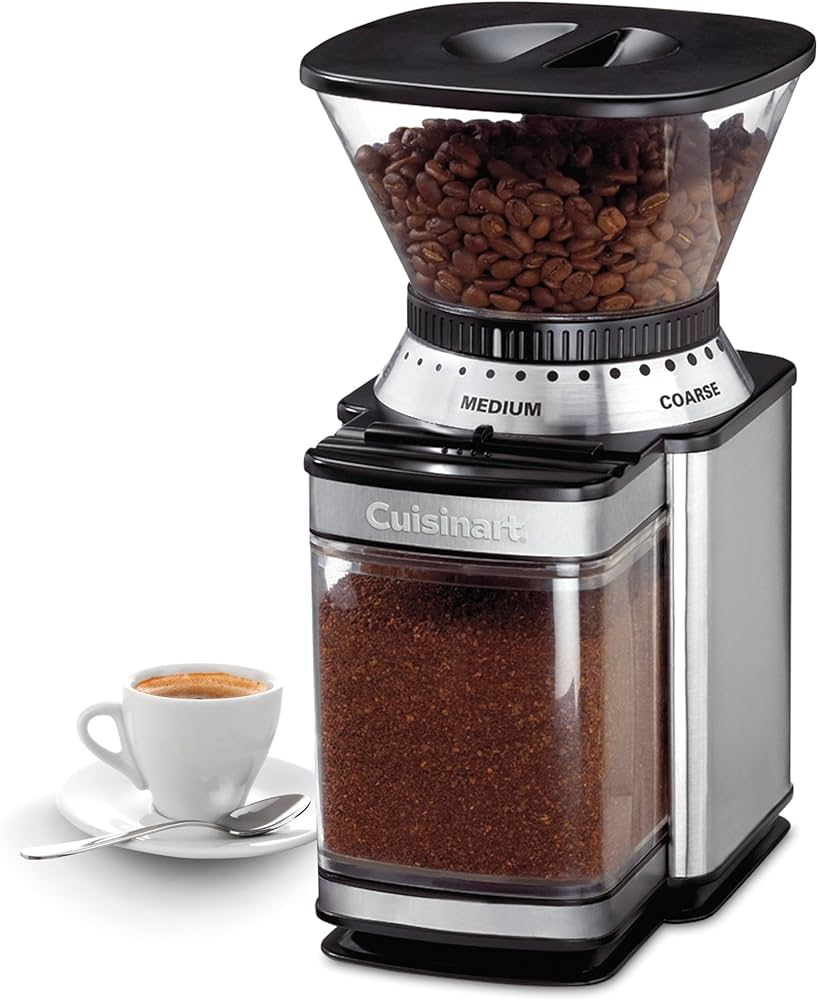
The Big Showdown: Burr vs. Blade Grinders
When you start your search, you’ll see two main types of grinders: blade and burr. This isn’t just a minor detail; it’s the whole ball game.
A blade “grinder” is a bit of a misnomer. It doesn’t really grind; it smashes. It uses a spinning blade, much like a blender, to obliterate the coffee beans into a mix of fine dust and large chunks. This inconsistency, as we just discussed, is the enemy of good coffee.
A burr grinder, on the other hand, uses two abrasive surfaces (the burrs) to crush and grind the beans into a uniform size. One burr is stationary while the other rotates. You adjust the distance between them to precisely control your grind size. This is the method the pros use, and it’s what you should be looking for.
Here’s a quick breakdown:
| Feature | Burr Grinder | Blade Grinder |
|---|---|---|
| Mechanism | Crushes beans between two revolving burrs | Smashes beans with a spinning blade |
| Grind Consistency | Highly consistent and uniform | Highly inconsistent (dust and boulders) |
| Control | Precise control over grind size | Little to no control |
| Heat Generation | Minimal, preserving coffee oils | High, can scorch the beans |
| Best For | Anyone serious about coffee quality | Spices (seriously, don’t use it for coffee) |
How to Choose the Best Manual Coffee Grinder for Your Brew
Okay, so you’re sold on a burr grinder. Fantastic! Now, how do you pick the right one? The best manual coffee grinder for me might not be the best for you. It depends entirely on your needs. Let’s break it down.
What’s Your Brewing Method?
Your brewer dictates your ideal grind size.
- French Press or Cold Brew: You’ll need a very coarse grind. Most manual grinders can handle this with ease.
- Pour-Over (V60, Chemex) or Drip: This is the sweet spot for most hand grinders, requiring a medium to medium-fine grind. A quality grinder will give you the consistency needed for a clean, vibrant cup.
- Espresso or Moka Pot: This is where things get serious. Espresso requires an extremely fine and consistent grind. Only high-end manual grinders are truly capable of producing an espresso-quality grind. If espresso is your daily driver, be prepared to invest in a top-tier model.
Let’s Talk Budget
Manual grinders range from around $20 to over $300.
- Entry-Level (Under $50): These are often equipped with ceramic burrs. They are a massive step up from a blade grinder and are perfect for French press or drip coffee. They might take a bit longer to grind and have less precise adjustments.
- Mid-Range ($50 – $150): Here you’ll start seeing stainless steel burrs, better build quality (metal bodies), and more precise grind settings. These are the workhorses for serious home brewers who focus on pour-over or AeroPress.
- Premium (Over $150): These are precision-engineered machines. Think razor-sharp, specialized steel burrs, micro-step adjustments for dialing in espresso, and flawless build quality. They grind faster, more consistently, and are a joy to use.
What Does Your Daily Coffee Ritual Look Like?
Think about how and where you’ll be using your grinder.
- The Homebody: If your grinder will live on your kitchen counter, you might prioritize a larger capacity and a stable, comfortable design over portability.
- The Traveler or Camper: Portability is key. Look for a compact, durable grinder that can fit inside an AeroPress. Many of the best travel grinders don’t sacrifice quality for size.
- The Espresso Enthusiast: You need precision above all else. Look for a grinder with a high number of adjustment steps (or “clicks”) to perfectly dial in your shot.
As renowned barista judge Isabella Rossi once told me, “The grinder is the artist’s brush. Without precise control over your grind, you’re just throwing paint at a canvas and hoping for the best. A great manual grinder puts the brush in your hand.”
Key Features to Look For in a Manual Grinder
Beyond the basics, here are a few features to keep an eye on:
- Burr Material & Size: Steel burrs are generally sharper and faster, while ceramic burrs are very durable and don’t conduct heat. Larger burrs mean faster, more efficient grinding.
- Adjustment Mechanism: How do you change the grind size? A stepped adjustment (with clicks) is easy to replicate. A stepless adjustment offers infinite control but can be harder to dial back to a previous setting.
- Build Quality: Look for metal components over plastic. A solid construction means better stability for the burrs, which translates to a more consistent grind.
- Ergonomics & Ease of Use: How does it feel in your hand? Is the handle comfortable? Is it easy to load beans and get the grounds out? These small details make a big difference in your daily routine.
Pro Tips: Using and Maintaining Your Grinder
You’ve found the perfect grinder! Here’s how to keep it in top shape.
- Dialing In: Don’t be afraid to experiment! Start with the manufacturer’s recommendation for your brew method, then make small adjustments. Grind a small amount, see how it looks and feels, and tweak until your coffee tastes amazing.
- Cleaning is Crucial: Coffee oils and fines build up over time, which can go rancid and make your coffee taste off. You should regularly disassemble your grinder and brush out the burrs and chamber.
- Avoid “Seasoning” Myths: You don’t need to grind a pound of cheap coffee through a new grinder. A simple clean is all it needs before its first use.
- Don’t Wash with Water (Unless specified): Most metal burrs can rust. Stick to a dry brush and a can of compressed air for cleaning unless the manual says otherwise.
Common Grinding Mistakes and How to Fix Them
I’ve seen it all, and here are a few common hiccups to avoid:
- Mistake: Storing beans in the hopper. This exposes them to air, making them go stale faster. Only grind what you need, right before you brew.
- Mistake: Not cleaning your grinder. As mentioned, old grounds will ruin the taste of your fresh coffee. Make cleaning a weekly or bi-weekly ritual.
- Mistake: Guessing the grind setting. Keep a small notebook or use an app to track your favorite settings for different beans and brew methods. Consistency is key!
Frequently Asked Questions
Is a manual grinder really better than an electric one?
For the price, absolutely. A $100 manual grinder will produce a far more consistent grind than a $100 electric grinder. To match the grind quality of a top-tier manual grinder, you’d often need to spend two or three times as much on an electric model.
How long does it take to grind coffee by hand?
It depends on the grinder’s quality, the grind setting, and the dose. For a typical 20-gram dose for a pour-over, a good mid-range grinder will take about 30-60 seconds. Finer settings, like for espresso, will naturally take a bit longer.
Are ceramic or steel burrs better?
It’s a matter of preference. Steel burrs are often sharper, leading to faster grinding with fewer fine particles. Ceramic burrs are more resistant to wear and don’t heat up, but they can be more brittle. For most users, a quality set of steel burrs is the preferred choice today.
Can I use a manual grinder for espresso?
Yes, but you need the right one. Look for a grinder with a precise, micro-stepped adjustment mechanism and sharp, stable burrs. Entry-level hand grinders will struggle to produce a consistent enough grind for good espresso.
How often should I clean my manual coffee grinder?
For optimal flavor, a light cleaning (brushing out the burrs) every week is a good idea. A deep clean, where you fully disassemble the grinder, should be done every month or two, depending on how often you use it.
Choosing to grind your own coffee is a journey, not a destination. It’s a small ritual that pays huge dividends in flavor. Investing in the best manual coffee grinder for your needs empowers you to become your own favorite barista, creating café-quality coffee in the comfort of your own home. Now go on, get grinding! I’d love to hear about your experiences and which grinder you chose in the comments below.