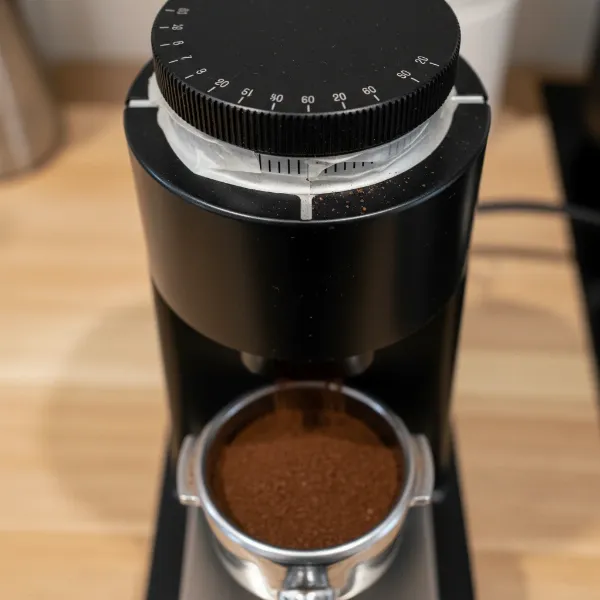
Opening a small cafe is a dream for many, but turning that dream into a thriving business requires more than just passion for coffee. It demands meticulous attention to every detail, especially when it comes to your equipment. While a gleaming espresso machine often steals the spotlight, the true workhorse behind every exceptional cup is your commercial coffee grinder. This essential piece of equipment dictates grind consistency, impacts flavor clarity, and ultimately sets the stage for your cafe’s reputation. Choosing the right commercial coffee grinder can significantly enhance your barista’s efficiency and elevate the coffee experience for your customers.
Understanding Commercial Coffee Grinders: Types and Technology
The world of coffee grinders can seem vast, but for commercial applications, the choice quickly narrows. Let’s explore the common types and why some are far superior for a bustling cafe environment.
Manual Grinders
Manual coffee grinders are typically hand-operated devices, prized for their portability and the tactile experience they offer. They don’t require electricity and often provide excellent control over grind size, making them popular among home enthusiasts and travelers.
- Advantages: Compact, silent operation, no electricity needed, fine grind control for small batches.
- Disadvantages: Labor-intensive, very slow for commercial volume, impractical for a cafe’s daily demands.
- Best For: Home use, travel, or very niche, extremely low-volume pour-over stations where speed is not a concern.
|
Our Picks for the Best Coffee grinder in 2026
As an Amazon Associate I earn from qualifying purchases.
|
||
| Num | Product | Action |
|---|---|---|
| 1 | Amazon Basics Electric Coffee Grinder, Coffee Bean and Spice Grinder, With Heavy-Duty Stainless Steel Grind Blades |

|
| 2 | Cuisinart Coffee Grinder, One Touch Control Coffee Bean Grinder with Stainless Steel Bowl and Blades, 2.5 oz/70g Capacity Enough for 12 Cups, On/Off Switch with Safety Interlock, DCG-20BKN, Black |
|
| 3 | Hamilton Beach Custom Grind Electric Coffee Grinder for 4-14 Cups, One-Press Hand-Free Operation with Auto Shutoff, Removable Grinding Bowl For Easy Pour and Clean, Stainless Steel (80406) |
|
| 4 | Wancle Electric Coffee Grinder, Spice Grinder, One Touch Coffee Mill for Beans, Spices and More, with Clean Brush Black |
|
| 5 | Automatic Coffee Machine, 20-Bar Pressure Espresso Maker with Built-in Grinder, 15-Precision Settings, One-Touch Latte & Cappuccino System, Smart Self-Cleaning |
|
| 6 | SHARDOR Professional Conical Burr Coffee Grinder, Coffee Bean Grinder with 48 Grind Settings for Espresso, Drip & French Press, Upgraded Anti-Static Technology, Precision Timer, Stainless Steel |
|
| 7 | BLACK+DECKER One Touch Coffee Grinder, 2/3 Cup Coffee Bean Capacity, Spice Grinder, One Touch Push-Button Control -150 Watts -Stainless Steel Blades |
|
| 8 | Hamilton Beach Fresh Grind Electric Coffee Grinder for Beans, Spices and More, Stainless Steel Blades, Removable Chamber, Makes up to 12 Cups, Black |
|
| 9 | OXO Brew Conical Burr Coffee Grinder - Silver, Stainless Steel Burrs, One-Touch Automatic Smart Grind |
|
| 10 | Cuisinart Coffee Grinder, Electric One-Touch Automatic Burr Coffee Grinder with 18-Position Grind Selector, Cup Size Selector for 4 – 18 Cups, DBM-8P1, Black Stainless |
|
Blade Grinders
Blade grinders operate more like blenders, using a spinning blade to chop coffee beans into particles. They are generally the least expensive option and readily available.
- Advantages: Low cost, easy to find.
- Disadvantages: Produce inconsistent grind sizes, generate excessive heat that degrades coffee flavor, create “coffee dust” rather than uniform particles.
- Best For: Strictly discouraged for any cafe aiming for quality. They cannot achieve the consistency needed for proper extraction.
Burr Grinders: The Heart of Your Cafe
Burr grinders are the undisputed standard for any professional coffee setting, including small cafes. Instead of chopping, they mill coffee beans between two abrasive surfaces (burrs) to create uniform particles. This precision is vital for consistent flavor extraction. Burr grinders come in two primary configurations: flat burr and conical burr.
Flat Burr Grinders
Flat burr grinders feature two parallel, flat burrs with cutting edges that face each other. Coffee beans are fed between them and ground as they move from the center outwards.
- Advantages: Renowned for producing exceptionally consistent and uniform grind particles, leading to a balanced and clear flavor profile in the cup. They often grind faster than conical burrs, especially larger ones, making them efficient for higher volume environments. Many high-end espresso grinders utilize flat burrs for their precision.
- Disadvantages: Can generate more heat due to friction during grinding, which can subtly impact delicate coffee flavors if not managed with cooling systems. They tend to be noisier and often come at a higher price point than conical alternatives. Adjusting the grind setting on some models might require purging a small amount of coffee.
Conical Burr Grinders
Conical burr grinders feature two cone-shaped burrs – an outer ring and an inner cone – that fit inside each other. Beans are ground as they travel down between the burrs.
- Advantages: Often operate at lower RPMs, which means less heat generation, preserving the delicate aromatics and flavors of the coffee beans. They are generally quieter than flat burr grinders and tend to have a longer lifespan for their burrs. Conical burrs are sometimes praised for producing a more complex flavor profile with a sweeter taste and body. Their design allows for a natural, gravity-fed operation.
- Disadvantages: Historically, conical burrs were sometimes perceived as producing a slightly less uniform grind consistency compared to flat burrs, with a wider distribution of particle sizes. However, modern, high-quality conical burr grinders have significantly improved in consistency, making this less of a concern for top-tier models.
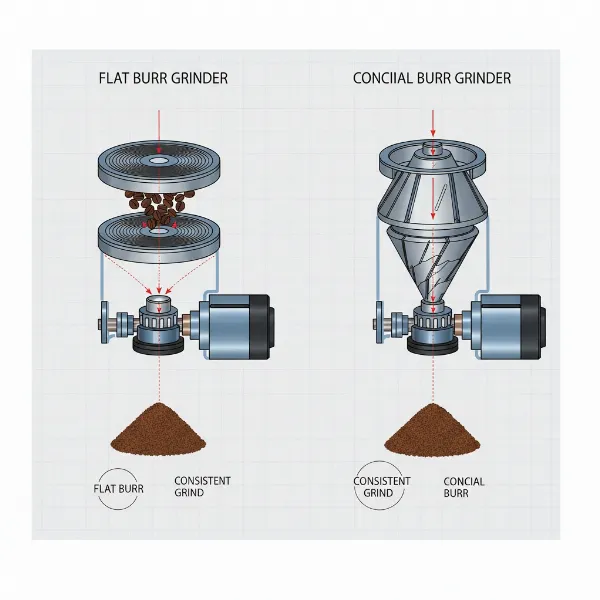 Diagram comparing flat and conical burr grinders, highlighting internal burr mechanisms and grind output.
Comparison Table: Flat vs. Conical Burr Grinders
| Feature | Flat Burr Grinders | Conical Burr Grinders |
|---|---|---|
| Grind Consistency | Very high, uniform particle distribution | High, may have slightly wider particle distribution (can benefit some brew methods) |
| Flavor Profile | Often highlights clarity, bright notes, clean finish | Can enhance sweetness, body, and flavor complexity |
| Heat Generation | Can be higher, especially with smaller burrs and high volume | Generally lower due to slower RPM and design |
| Noise Level | Can be louder | Generally quieter |
| Speed | Often faster for high-volume grinding | Efficient, lower RPM, steady grinding |
| Cost | Generally higher | Often more cost-effective for comparable quality |
| Burr Life | Good, requires eventual replacement | Often longer burr life due to less wear |
| Retention | Can have higher retention, but zero-retention models exist | Generally lower retention due to gravity-fed design |
Key Factors to Consider When Choosing a Commercial Coffee Grinder for Your Small Cafe
Selecting the ideal commercial coffee grinder for your small cafe involves more than just picking a popular brand. It’s about aligning the grinder’s capabilities with your specific operational needs and quality standards.
Cafe Volume and Workflow
Your cafe’s daily output and peak hour demands are crucial considerations. For a small cafe, you might not need the largest, highest-capacity grinder, but you still require a machine that can keep up without overheating or causing delays. A grinder that supports your barista’s workflow—allowing for quick adjustments and consistent dosing—is paramount. Grinders with larger burr sizes (e.g., 64mm and above) are generally recommended for commercial settings, even in smaller cafes, as they grind faster and generate less heat, preventing inconsistencies during busy periods.
Burr Type and Size
The choice between flat and conical burrs depends on your desired flavor profile and operational preferences. While flat burrs are favored for their superior consistency and clarity, conical burrs are praised for their heat management and nuanced flavor expression. For commercial use, irrespective of type, opt for durable burrs made from hardened steel or ceramic. The larger the burr diameter, typically the faster and cooler the grinding process, which is a significant advantage for any cafe.
Grind Consistency and Adjustability
Consistency is the cornerstone of excellent coffee. A high-quality commercial coffee grinder ensures that every particle is uniform, leading to an even extraction and a balanced cup, regardless of the brew method. Look for grinders with precise, stepless (or micro-stepped) grind adjustment systems. This allows your baristas to dial in the perfect grind for espresso, pour-over, or French press, adapting to different beans and environmental factors.
Dosing Method: On-Demand vs. Doser
Modern commercial grinders primarily offer “on-demand” grinding, where coffee is ground fresh for each shot or batch, minimizing waste and maximizing freshness. Within on-demand grinders, you’ll find:
- Time-based dosing: The grinder runs for a set duration. While common, it can be less precise as bean density varies.
- Grind-by-Weight (GbW): These advanced grinders weigh the ground coffee directly, providing unparalleled precision and consistency shot after shot. This technology significantly reduces waste and guesswork, making it a valuable asset for quality-focused cafes.
Durability and Build Quality
A commercial environment demands robust equipment. Invest in a coffee grinder built with high-quality materials, such as a sturdy metal casing and commercial-grade burrs (e.g., hardened steel). Reliability is key; frequent breakdowns or high maintenance costs can quickly eat into your profits and disrupt service.
Noise Level
Consider the impact of grinder noise on your cafe’s ambiance. While some noise is inevitable, excessively loud grinders can detract from the customer experience, especially in a smaller, more intimate setting. Conical burr grinders generally tend to be quieter than flat burr counterparts.
Footprint and Design
Space is often at a premium in small cafes. Look for grinders with a compact design that fits comfortably on your counter without hindering workflow. Practical design elements, such as easy-to-clean components and intuitive controls, also contribute to operational efficiency.
Budget and Maintenance
Commercial grinders represent a significant investment. Balance the initial cost with long-term value, considering durability, potential maintenance, and parts availability. A more expensive grinder that lasts longer and requires less servicing may be more economical in the long run than a cheaper model prone to issues.
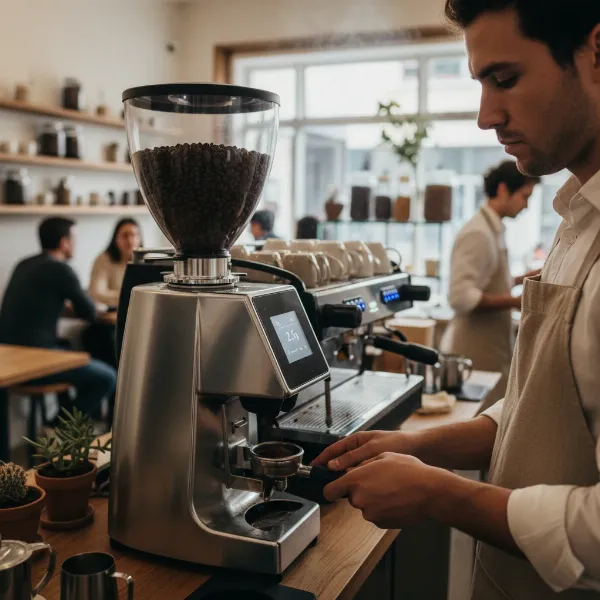 Barista operating a modern commercial espresso grinder in a bustling small cafe setting.
Top Picks: Best Commercial Coffee Grinders for Small Cafes
Based on expertise and the demands of a small cafe, here are some top recommendations for commercial coffee grinders that strike an excellent balance between performance, reliability, and value.
1. Mahlkönig E65S GbW – Precision and Efficiency
The Mahlkönig E65S GbW (Grind-by-Weight) stands out as a top-tier choice for cafes prioritizing ultimate precision and consistency. Its innovative grind-by-weight technology doses coffee accurately based on weight, not time, ensuring every shot is perfectly consistent.
- Pros: Exceptional grind-by-weight precision, highly consistent output, compact design, adjustable burrs for various brew methods, intuitive touchscreen interface.
- Cons: Higher price point, might be overkill for extremely low-volume operations.
2. Ceado E37S – A High-Volume Performer
The Ceado E37S is a legendary commercial flat burr grinder known for its speed and consistent grinding. With massive 83mm flat steel burrs and a powerful motor, it can handle significant volume while maintaining particle uniformity.
- Pros: Very fast grinding (up to 5g/second), excellent grind consistency, surprisingly quiet for a commercial grinder, robust build quality, durable.
- Cons: Larger footprint than some alternatives, primarily time-based dosing (though very reliable).
3. Eureka Atom 75 W / Eureka Helios 65 – Reliable and Quiet
Eureka’s commercial line offers robust performance with an emphasis on quiet operation. The Atom 75 W, with its grind-by-weight technology, provides café-level speed and precision, while the Helios 65 is another solid contender for espresso.
- Pros: Grind-by-weight (Atom 75 W), “Silent Technology” for reduced noise, highly consistent espresso grind, easy stepless micro-adjustment, durable flat burrs.
- Cons: Primarily optimized for espresso, some models may be less versatile for other coarse grind methods without recalibration.
4. Fiorenzato F64 Evo Pro – Value and Consistency
The Fiorenzato F64 Evo Pro offers an impressive blend of durability, precision, and competitive pricing, making it an excellent value proposition for small cafes. It features 64mm flat steel burrs and stepless micro-adjustment.
- Pros: Durable build with a sharp aesthetic, precise and consistent grinding, powerful motor (350W), stepless micrometric grind adjustment, often more affordable than comparable high-end models.
- Cons: May lack some of the advanced digital features (like integrated grind-by-weight) found in higher-priced competitors.
“Your coffee grinder is the single most important tool for making great coffee. More important than your espresso machine, or even the coffee beans themselves.” – Marc, Coffee Equipment Expert
Conclusion
Choosing the best commercial coffee grinder for your small cafe is a critical decision that impacts every cup you serve. By understanding the differences between burr types, evaluating factors like cafe volume, grind consistency, and dosing methods, and considering reliable brands, you can make an informed investment. A high-quality commercial coffee grinder ensures consistent extraction, rich flavor, and a smooth workflow for your baristas, ultimately enhancing customer satisfaction and cementing your cafe’s reputation for excellence. Don’t underestimate its importance; your grinder is truly the heart of your coffee operation. What will be the defining grinder that elevates your cafe’s coffee experience?
Frequently Asked Questions
What burr size is best for a small cafe?
For most small cafes, a commercial grinder with burrs 64mm or larger is highly recommended. Larger burrs grind faster, produce less heat, and maintain better consistency during peak hours, which is crucial for quality and efficiency.
How often should I clean my commercial coffee grinder?
Regular cleaning is vital. Daily purging with grinder cleaning tablets and brushing grounds from the chute is recommended. A more thorough cleaning, including disassembling and cleaning the burrs, should be done weekly or bi-weekly depending on usage, to prevent stale coffee oils from impacting flavor.
Is a grind-by-weight grinder worth it for a small cafe?
Absolutely. While a higher initial investment, a grind-by-weight grinder virtually eliminates waste from inconsistent dosing and guarantees precise coffee quantities for every shot. This leads to better quality control, reduced coffee bean waste, and significant cost savings over time for a busy small cafe.
What’s the difference between espresso grinders and bulk grinders?
Espresso grinders are designed for very fine, precise, and consistent grinding for espresso, often with on-demand dosing. Bulk grinders, or shop grinders, are built for larger quantities and typically offer a wider range of grind sizes suitable for drip coffee, French press, or pre-grinding for retail, but may lack espresso-level fine adjustment.
Can I use a home coffee grinder in a small cafe?
Using a home Coffee Grinder in a commercial setting is strongly discouraged. Home grinders are not designed for the continuous use, high volume, and precise consistency required by a cafe. They will quickly overheat, wear out, and produce inconsistent results, compromising coffee quality and operational efficiency.
How important is grind consistency for coffee flavor?
Grind consistency is paramount for optimal coffee flavor. Unevenly ground coffee results in uneven extraction—some particles will be over-extracted (bitter), and others under-extracted (sour)—leading to a muddled, unpleasant cup. A consistent grind ensures even water flow and balanced flavor extraction.