The journey to an exceptional cup of coffee begins long before the hot water meets the grounds; it starts with the perfect grind. For over a decade as a coffee grinder technician, I’ve seen countless machines come and go, but few have earned the respect and loyalty of home baristas quite like the Rancilio Rocky Espresso Coffee Grinder. Renowned for its industrial build, consistent performance, and remarkable durability, the Rocky stands as a testament to quality in a rapidly evolving market. This comprehensive review will delve into its core features, explore its capabilities across various brew methods, and help you determine if this classic grinder is the right investment for your coffee passion.
The Heart of the Grind: Rancilio Rocky’s Design and Burr Quality
The moment you encounter the Rancilio Rocky, its commercial heritage is unmistakable. Encased in a polished metal body, featuring high-grade aluminum and stainless steel, it presents an industrial aesthetic that is both robust and timeless. This isn’t just for show; the Rocky’s substantial weight, tipping the scales at around 15.4 pounds (7 kg), speaks volumes about its sturdy construction. It feels like a serious piece of equipment, built to withstand years of daily use, not merely a fleeting gadget for the kitchen counter. At its core, the Rocky houses a powerful, commercial-grade motor, a characteristic often found in much larger, more expensive units. This motor is engineered to handle even the densest coffee beans with ease, ensuring a consistent grind without excessive heat buildup, which can negatively impact flavor.
Perhaps the most critical component of any coffee grinder is its burr set, and the Rancilio Rocky shines here with its 50mm flat tempered steel burrs. These burrs are precision-engineered to deliver a remarkably uniform grind particle size, a non-negotiable factor for extracting the best possible flavors from your coffee, especially crucial for espresso. Unlike blade grinders that merely chop beans inconsistently, the Rocky’s burrs meticulously crush them, resulting in a consistent texture that forms the foundation of a truly great brew. The robust metal casing not only contributes to the grinder’s aesthetic and durability but also plays a role in its acoustics. Paired with its efficient motor, the Rocky operates quieter than many other consumer-grade grinders on the market, a welcome feature for early morning coffee rituals.
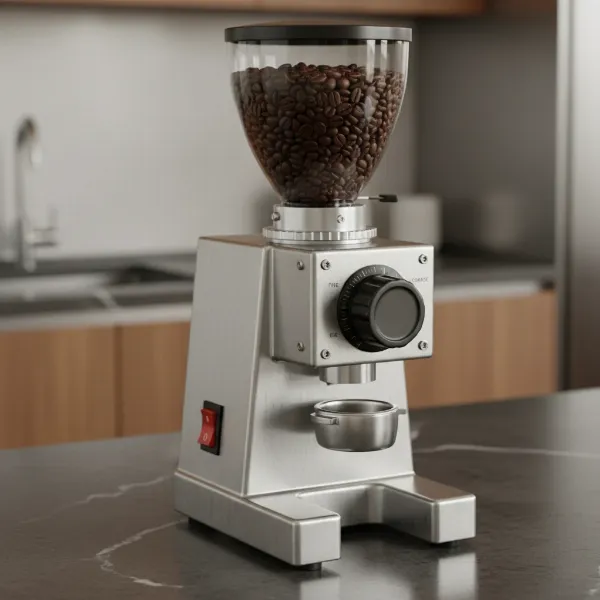 Rancilio Rocky espresso coffee grinder with its industrial design and robust build
Mastering Your Brew: Grind Settings and Versatility
One of the Rancilio Rocky’s defining characteristics is its 55 stepped grind settings. While some advanced espresso enthusiasts might prefer a stepless design for infinitely fine adjustments, the Rocky’s stepped system offers a commendable balance. It provides enough granularity for precise control, particularly for espresso, while remaining intuitive and user-friendly for those new to the world of home grinding. The increments between settings are fine enough to significantly impact your espresso extraction, allowing you to dial in your shot with satisfying accuracy.
The Rocky’s versatility extends far beyond espresso. Its broad range of settings makes it a true all-rounder, capable of producing the ideal grind for virtually any brewing method. For espresso, settings typically range from 0-10, yielding a powdery, consistent fine grind. If you’re into pour-over, a medium-fine grind between 10-20 will suit. For drip brewers, a medium grind from 25-35 is often recommended, and for the beloved French Press, you can go as coarse as 40+. This adaptability means you don’t need multiple grinders for different coffee preparations, making the Rocky a cost-effective and space-saving solution for a varied coffee palate. Furthermore, a thoughtful design feature is the built-in screw that prevents the burrs from grinding against each other at the finest settings. This not only preserves the sharpness and quality of the burrs over time but also safeguards the motor from unnecessary strain, extending the grinder’s operational life.
User Experience: Operation, Dosing, and Maintenance
Operating the Rancilio Rocky is straightforward, embodying a no-frills approach that prioritizes functionality. It’s a manual dosing grinder, meaning it grinds coffee only when you press a button, giving you direct control over the quantity. The doserless model, a popular choice, features a convenient chute and a removable metal portafilter holder. This design allows you to grind directly into your espresso machine’s portafilter, minimizing mess and maximizing efficiency. For other brew methods, you can simply remove the holder and grind into any container.
The hopper has a capacity of approximately 8 to 10.5 ounces of whole beans, suitable for daily home use without constant refilling. While some modern grinders boast “zero retention” designs, the Rocky, for its class, demonstrates minimal retention, meaning very little old coffee grounds are left behind to contaminate your fresh brew. This is a significant advantage over many entry-level grinders. However, it’s worth noting that adjusting the grind settings can sometimes be a bit stiff. It requires holding down a locking mechanism while simultaneously turning the hopper, which some users find a little cumbersome initially. Nevertheless, with a bit of practice, it becomes second nature.
Cleaning and maintaining the Rancilio Rocky is refreshingly simple. Its robust construction allows for easy disassembly, making access to the burrs for routine cleaning or eventual replacement a hassle-free process. This ease of maintenance is a major contributor to its long-standing reputation for durability. Regular cleaning will ensure your Rocky continues to deliver consistent, flavorful grounds for many years.
Rancilio Rocky Doser vs. Doserless: Choosing Your Model
When considering the Rancilio Rocky, you’ll typically encounter two primary models: the Doser and the Doserless. Each caters to slightly different preferences and workflows.
-
Rancilio Rocky Doserless: This model, often preferred by home baristas, comes with a direct dispensing chute and a removable portafilter holder. It allows for grinding coffee directly into your espresso portafilter or any other container, providing immediate access to freshly ground coffee with minimal waste. It’s ideal for single-dosing or grinding exactly what you need for each brew, enhancing freshness.
-
Rancilio Rocky Doser: The doser model includes a grounds catcher with a lever mechanism to dispense coffee. While less common in modern home setups focused on ultimate freshness, it can be useful for those who prefer to grind a batch of coffee and then dispense pre-measured doses. This might be suited for specific scenarios or those accustomed to a more traditional commercial workflow.
For most home users seeking maximum freshness and control over their dose, the Doserless model is generally the recommended choice, offering a clean and direct path from bean to brew.
Is the Rancilio Rocky Right for Your Coffee Journey?
The Rancilio Rocky is an icon for a reason, but like any piece of equipment, it excels in certain scenarios more than others.
It’s an ideal choice for:
- Serious Home Baristas: If you’re dedicated to improving your home coffee experience and demand consistent, high-quality grinds for various brew methods, especially espresso, the Rocky will not disappoint.
- Those Prioritizing Durability and Longevity: The commercial-grade components mean this grinder is built to last for many years, offering excellent return on investment.
- Users Seeking Versatility: Its wide grind range makes it suitable for everything from Turkish coffee (with careful adjustment) to French Press, making it a single solution for diverse brewing needs.
- Appreciators of Industrial Quality: If you value robust construction and a no-nonsense, functional design, the Rocky’s aesthetic will appeal to you.
You might consider alternatives if:
- You Require Stepless Micro-Adjustments: For extremely precise, hair-splitting adjustments often sought by highly experienced espresso aficionados, a stepless grinder might offer more granular control.
- You Demand Absolute Zero Retention for Single-Dosing: While the Rocky has minimal retention, it’s not designed from the ground up as a zero-retention grinder, which some dedicated single-dosers prioritize.
- You’re on a Very Strict Budget for a Beginner Grinder: While offering great value for its quality, the initial investment for a Rocky is higher than entry-level blade or manual grinders.
“Built with the same renowned quality as its commercial grinders, the Rancilio Rocky is one of the best at its price point.” – Felicia, Espresso Machine and Coffee Expert, Seattle Coffee Gear
Rancilio Rocky’s Performance at a Glance
| Feature | Rancilio Rocky’s Performance |
|---|---|
| Grind Quality | Very good, consistent for espresso, versatile for all methods |
| Price Point | Mid-to-High range for home grinders, good value for durability/quality |
| Noise Level | Relatively quiet for its power, thanks to metal casing and efficient motor |
| Durability | Excellent, built with commercial-grade components to last years |
| Portability | Low (heavy at 15.4 lbs / 7 kg), designed for stationary use |
| Adjustability | 55 stepped settings, fine increments but not stepless |
| Retention | Minimal for a grinder of its type, but not zero retention |
Conclusion
The Rancilio Rocky Espresso Coffee Grinder has carved out its legacy as a formidable workhorse in the home barista community, and for good reason. It stands as a testament to the enduring appeal of robust build quality, consistent grind performance, and versatility across a wide spectrum of brew methods. While newer grinders may offer more advanced features like stepless adjustment or ultra-low retention, the Rocky’s unwavering reliability and the quality of its 50mm flat burrs continue to make it a compelling choice. It’s not just a grinder; it’s an investment in years of superior coffee. If you’re seeking a grinder that brings commercial-grade dependability and consistent grind quality to your countertop, the Rancilio Rocky remains a top contender, promising to elevate your daily coffee ritual. What brewing method are you most excited to perfect with a quality grinder like the Rocky?
Frequently Asked Questions
How many grind settings does the Rancilio Rocky have?
|
Our Picks for the Best Coffee grinder in 2026
As an Amazon Associate I earn from qualifying purchases.
|
||
| Num | Product | Action |
|---|---|---|
| 1 | BLACK+DECKER One Touch Coffee Grinder, 2/3 Cup Coffee Bean Capacity, Spice Grinder, One Touch Push-Button Control -150 Watts -Stainless Steel Blades |

|
| 2 | Cuisinart Coffee Grinder, One Touch Control Coffee Bean Grinder with Stainless Steel Bowl and Blades, 2.5 oz/70g Capacity Enough for 12 Cups, On/Off Switch with Safety Interlock, DCG-20BKN, Black |
|
| 3 | OXO Brew Conical Burr Coffee Grinder - Silver, Stainless Steel Burrs, One-Touch Automatic Smart Grind |
|
| 4 | SHARDOR Professional Conical Burr Coffee Grinder, Coffee Bean Grinder with 48 Grind Settings for Espresso, Drip & French Press, Upgraded Anti-Static Technology, Precision Timer, Stainless Steel |
|
| 5 | Automatic Coffee Machine, 20-Bar Pressure Espresso Maker with Built-in Grinder, 15-Precision Settings, One-Touch Latte & Cappuccino System, Smart Self-Cleaning |
|
| 6 | Cuisinart Coffee Grinder, Electric One-Touch Automatic Burr Coffee Grinder with 18-Position Grind Selector, Cup Size Selector for 4 – 18 Cups, DBM-8P1, Black Stainless |
|
| 7 | Hamilton Beach Fresh Grind Electric Coffee Grinder for Beans, Spices and More, Stainless Steel Blades, Removable Chamber, Makes up to 12 Cups, Black |
|
| 8 | Amazon Basics Electric Coffee Grinder, Coffee Bean and Spice Grinder, With Heavy-Duty Stainless Steel Grind Blades |
|
| 9 | Wancle Electric Coffee Grinder, Spice Grinder, One Touch Coffee Mill for Beans, Spices and More, with Clean Brush Black |
|
| 10 | Hamilton Beach Custom Grind Electric Coffee Grinder for 4-14 Cups, One-Press Hand-Free Operation with Auto Shutoff, Removable Grinding Bowl For Easy Pour and Clean, Stainless Steel (80406) |
|
The Rancilio Rocky typically features 55 stepped grind settings. These settings offer a wide range of adjustment from very fine for espresso to coarse for French press, providing sufficient control for most home brewing methods.
Is the Rancilio Rocky good for espresso?
Yes, the Rancilio Rocky is highly regarded for its espresso grinding capabilities. Its 50mm flat tempered steel burrs and fine stepped adjustments allow for the production of consistent, uniform grounds essential for excellent espresso extraction.
Can I use the Rancilio Rocky for French Press?
Absolutely. The Rancilio Rocky’s wide range of 55 grind settings includes coarser options (typically from setting 40 upwards), making it perfectly capable of producing the coarse, consistent grind required for French press brewing.
Is the Rancilio Rocky a doser or doserless grinder?
The Rancilio Rocky is available in both doser and doserless versions. The doserless model, with its direct chute and portafilter holder, is popular for its simplicity and minimal mess, while the doser model allows for pre-measured dispensing.
How do I clean my Rancilio Rocky coffee grinder?
Cleaning the Rancilio Rocky is relatively straightforward. You can easily disassemble the top burr and hopper to access the burr chamber. Regular brushing out of grounds and occasional deeper cleaning with a grinder cleaner will maintain optimal performance and prolong its lifespan.